November 2, 2026 · admin
For manufacturers searching for ultrasonic welding Delhi solutions, JSB Ultrasonic (JSB Automation) supplies and services ultrasonic plastic welding machines from its base at N-76, DSIIDC Industrial Area, Sector 1, Bawana, New Delhi 110039. The support process can include machine supply, delivery, installation, sample trials on customer parts and after-sales service. This gives production teams a practical way to assess a welding application before finalising equipment and tooling.
The right machine is determined by the part, polymer, joint design, cycle requirements and production method—not by frequency or power alone. JSB can discuss the application, conduct sample trials on customer parts, and provide relevant tooling such as custom horns and fixtures. For a local overview of the company’s offering, see the ultrasonic plastic welding machine supplier page for Delhi.
What Delhi manufacturers should assess before buying
Delhi has a broad manufacturing base, including production activity involving plastic components, packaging, electronics, automotive parts, medical-related products and consumer goods. Each application presents different joining conditions. A compact enclosure may need a controlled cosmetic weld, while an internal component may require strength, retention or leak resistance. A filter, cup, housing, cover or assembly can therefore require a different horn, fixture and process window even when the material appears similar.
Before requesting a quotation or machine recommendation, prepare representative samples and define the most important result. Useful information includes:
- The component drawings or physical parts, including the proposed weld line.
- Material information for both mating parts, including filled or modified grades where relevant.
- Required joint function, such as structural joining, sealing, staking, insertion or film cutting.
- Part dimensions, tolerances and the surfaces that must remain free from visible marks.
- Expected production method, operator involvement and the number of welds in the assembly.
- Any known issues from existing joining methods, such as flash, inconsistent strength or distortion.
This information helps separate a machine requirement from a tooling requirement. In many cases, the horn and fixture have as much influence on the result as the generator and press.
How ultrasonic plastic welding works in production
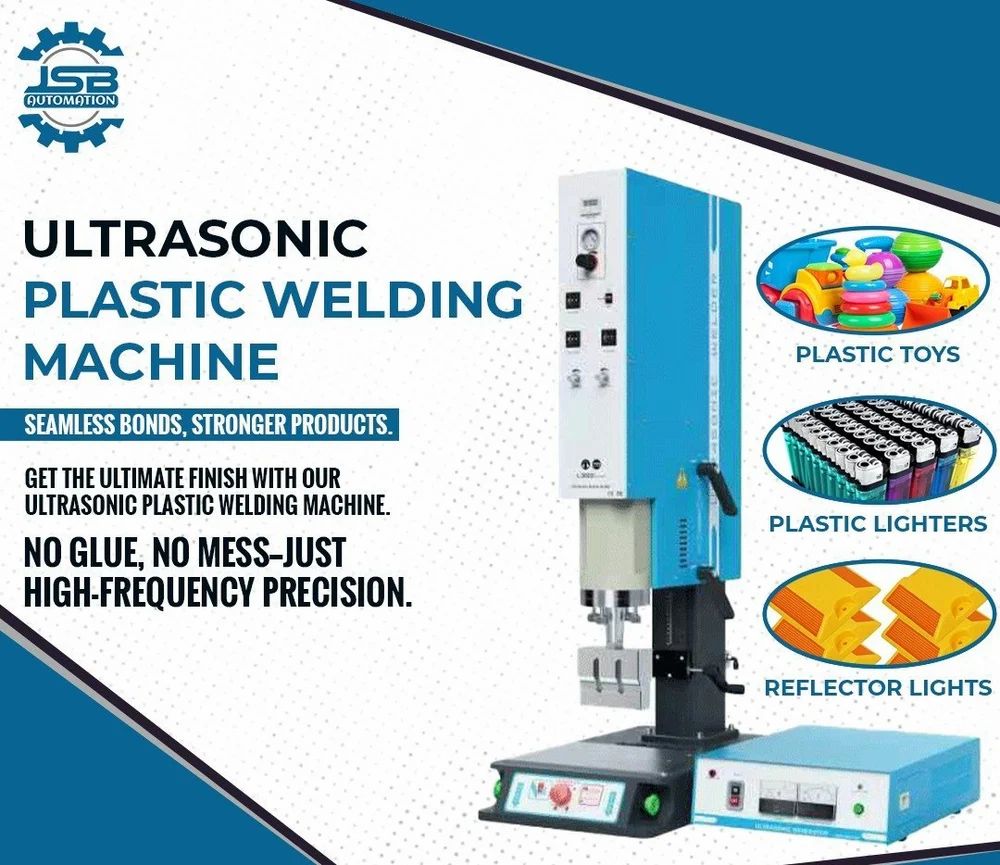
An ultrasonic plastic welding machine converts electrical energy into mechanical vibration. The vibration is transferred through the horn to the parts while the assembly is held under force. At the joint interface, the designed contact features concentrate energy and cause localised softening or melting of compatible thermoplastic material. Once the vibration stops, the parts remain clamped while the joint cools and solidifies.
The process is fast and repeatable when the part design, material pairing, tooling and machine settings are suitable. However, ultrasonic welding is not a universal solution for every plastic combination or joint shape. Material compatibility, moisture, fillers, wall thickness, energy director geometry and part rigidity can all affect the weld.
For Delhi production engineers, the important question is not simply whether ultrasonic welding is available. It is whether the proposed process can produce the required joint consistently on the actual customer part. That is why sample trials are valuable before equipment selection.
Choosing the machine around the application
Frequency and power
Frequency and power should be selected around the component size, joint design, material behaviour and required weld energy. Smaller or more detailed components may call for a different operating range from larger assemblies. A higher power rating does not automatically produce a better weld; excessive energy can mark, deform or damage a component, while insufficient energy can produce an incomplete joint.
JSB’s listed ultrasonic plastic welding machines include configurations such as a 15 kHz, 1500 W semi-automatic machine with power mode and a 15 kHz, 2600 W semi-automatic machine with energy, depth and time modes. These specifications describe available machine configurations, not a universal recommendation. The appropriate choice should be confirmed through the part and tooling evaluation.
Control mode and process monitoring
Different applications may be controlled by time, energy, depth, power or another programmed condition. Time mode can be useful when the process is already well understood, while energy or depth control may offer a closer relationship to the joining event in suitable applications. The best control approach depends on the joint and the quality requirements.
During a trial, the process team should observe weld appearance, part alignment, horn contact, holding force and joint performance. If the result changes when parts move slightly in the fixture, the issue may be location or support rather than the nominal machine setting.
Manual and semi-automatic operation
A manual machine can suit applications where loading, unloading or part variation requires operator involvement. A semi-automatic arrangement may be appropriate when the part can be positioned consistently and the process needs a more defined operating sequence. The choice should reflect the assembly design, handling method and desired production workflow.
Why horns and fixtures matter in Delhi applications
The horn transfers vibration to the part, so its contact surface must match the weld area and the geometry must be designed for the application. A horn that contacts unevenly can produce variable energy transfer, visible marks or incomplete joining. Its material, shape, amplitude behaviour and contact condition all need consideration.
The fixture supports the lower component and keeps the mating parts aligned during welding. It must resist movement without damaging surfaces. Poor support can allow the part to flex, shift or absorb vibration in an uncontrolled way. This may appear to be a machine problem when the root cause is fixture design.
JSB provides custom horns and fixtures for relevant applications. Customer parts should be discussed before tooling is finalised. For a deeper look at the design considerations, read the ultrasonic horn design guide. The article on plastic materials suitable for ultrasonic welding may also help teams prepare material information for a technical discussion.
What a sample trial should establish
A sample trial on customer parts should be treated as a process investigation, not only as a demonstration. Bring the actual components, proposed mating parts and any important cosmetic samples. If the production part is not yet available, clearly identify whether the trial uses a prototype, a substitute or a representative geometry.
A useful trial should help answer questions such as:
- Does the proposed joint design allow sufficient energy transfer?
- Are the materials and surfaces suitable for the intended weld?
- Can the fixture hold the parts in the correct position?
- Does the horn contact the intended area without damaging adjacent features?
- Which process variables affect appearance, strength or sealing performance?
- What changes to the joint, part support or tooling may be required?
Results should be evaluated against the customer’s own acceptance criteria. Visual appearance alone is not enough for a structural or sealing application. Depending on the product, the evaluation may include dimensional checks, pull or break testing, leak testing or functional assembly checks. The appropriate test is determined by the part and its use.
Installation and after-sales support
Machine supply is only one part of putting a welding process into production. Installation should cover the machine position, utilities, operating sequence, tooling fitment and basic process setup. Operators and maintenance personnel should understand safe operation, routine checks and the conditions that can affect weld consistency.
After installation, production teams may need support when a new material, part revision or tooling change is introduced. Horn wear, fixture damage, loose mounting, contamination and changes in part dimensions can all influence the result. JSB offers after-sales service and spare horns for relevant requirements. Keeping the horn and fixture in good condition is part of maintaining the process, not an optional extra.
For general maintenance planning, see the ultrasonic welding machine maintenance checklist. It can be used alongside the machine supplier’s application-specific guidance.
Questions to ask an ultrasonic welding supplier
When comparing suppliers for an application in Delhi, buyers should ask practical questions rather than relying only on a catalogue rating. Consider the following:
- Can the supplier review the actual parts and proposed weld joint?
- Are sample trials available on customer parts?
- Will the horn and fixture be designed for the component?
- Which operating modes and machine configuration suit the application?
- What installation support is included in the project discussion?
- How will spare horns and after-sales service be handled?
These questions help the purchasing team evaluate the complete process: machine, tooling, installation and ongoing support. They also reduce the risk of selecting equipment based only on frequency, power or a product photograph.
Frequently asked questions
Does JSB supply ultrasonic plastic welding machines in Delhi?
Yes. JSB Ultrasonic (JSB Automation) supplies and services customers in Delhi from its base in Bawana, New Delhi. Services can include machine supply, delivery, installation, sample trials on customer parts and after-sales service.
Can JSB test our plastic parts before machine selection?
Yes. JSB offers sample trials on customer parts. The trial can help assess material compatibility, joint design, tooling needs and suitable machine configuration.
Does every plastic part use the same ultrasonic welding machine?
No. The suitable machine, horn, fixture and process settings depend on the part geometry, material, joint design, production method and required result.
What should we send when requesting a technical discussion?
Share representative parts or drawings, material details, the intended joint function, production information and any current joining problems. This gives the application team a useful starting point.
Discuss your parts, arrange a sample trial or ask about a machine requirement with JSB Ultrasonic (JSB Automation). The team is based at N-76, DSIIDC Industrial Area, Sector 1, Bawana, New Delhi 110039 and can discuss supply, installation, custom horns and fixtures, and after-sales service for your Delhi manufacturing application.