November 5, 2026 · admin
For manufacturers searching for ultrasonic welding bawana solutions, the right machine should be selected from the part, material, joint design and production method—not from power rating alone. A suitable ultrasonic plastic welding machine must deliver consistent energy to the joint while holding the components securely and meeting the required cycle and quality expectations.
JSB Ultrasonic (JSB Automation) supplies and services customers in Bawana from its base at N-76, DSIIDC Industrial Area, Sector 1, Bawana, New Delhi 110039. Its support includes machine supply, delivery, installation, sample trials on customer parts and after-sales service. The selection process below is intended for production engineers, plant owners and buyers evaluating equipment for plastic components made in and around Bawana’s industrial manufacturing environment.
Start with the part and the weld requirement
Before comparing machines, define what the finished assembly must achieve. Ultrasonic welding can join compatible thermoplastic parts by converting high-frequency vibration into heat at the joint. The process is fast, but the result depends heavily on the component design and the way the parts are supported.
- Joint function: Decide whether the weld must provide structural strength, enclosure sealing, tamper evidence, appearance or a combination of these requirements.
- Part dimensions: Record the overall size, weld perimeter, wall thickness and any features close to the weld area.
- Material combination: Identify the exact grades where possible, including whether the parts are filled, reinforced, painted or blended. Similar-looking plastics may respond differently to ultrasonic energy.
- Production objective: Establish expected output, operator involvement, inspection requirements and the level of repeatability needed.
A sample trial on actual customer parts is valuable because a weld that appears suitable on a drawing may behave differently after moulding. The trial can help evaluate the joint, horn contact, fixture support and process settings before a machine is finalised.
Check material compatibility and joint design
Ultrasonic welding is generally most predictable when the materials can transmit vibration and soften in a controlled way at the interface. Common engineering plastics used in ultrasonic applications include PP, ABS, PE, PC, nylon and acrylic, but suitability depends on the specific part design and material combination.
The joint should guide energy to a defined contact area. An energy director, stepped joint or another suitable interface feature may be required, depending on the assembly. Large flat surfaces, uneven wall sections, deep cavities and flexible components can make energy transmission and alignment more difficult. The moulded parts should also be consistent; variation in flash, dimensions or warpage can affect the weld.
For a broader material review, see Plastic Materials Suitable for Ultrasonic Welding. If the choice is between two commonly used materials, the ABS vs PP Ultrasonic Welding Guide provides a useful starting point, while the final decision should still be confirmed on the actual parts.
Choose frequency and power for the application
Frequency and power should be considered together with part size, material, weld area and required amplitude. A higher power rating does not automatically mean a better weld. The machine must provide suitable vibration characteristics and enough energy for the application without damaging the component.
Frequency
Ultrasonic plastic welding systems are commonly configured at frequencies such as 15 kHz or 20 kHz. The appropriate frequency depends on the part, tooling, weld area and process window. Lower-frequency equipment is often considered for applications requiring greater amplitude or energy, while higher-frequency systems may suit smaller or more delicate components. These are general selection considerations, not rules for every part.
Review the 15 kHz vs 20 kHz Ultrasonic Plastic Welding Machine guide before making a decision. A tooling and sample assessment is more reliable than selecting frequency from part size alone.
Power
Power demand is influenced by the material, weld perimeter, joint design, cycle settings and the energy required to reach a stable weld. A machine that is too small may struggle to reach the required process condition. A machine with substantially more capacity is not automatically safer or more efficient if the horn, fixture and settings are unsuitable.
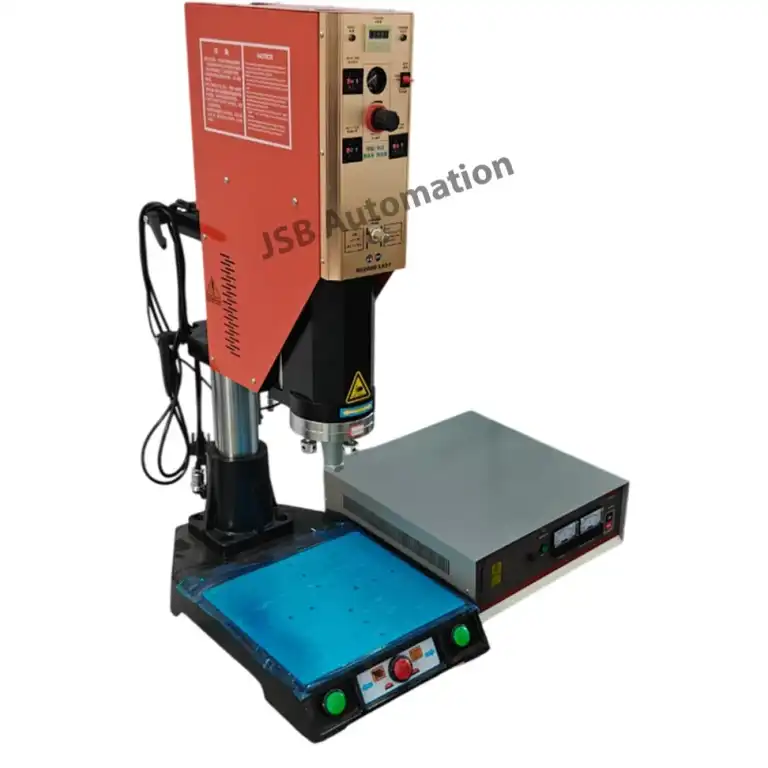
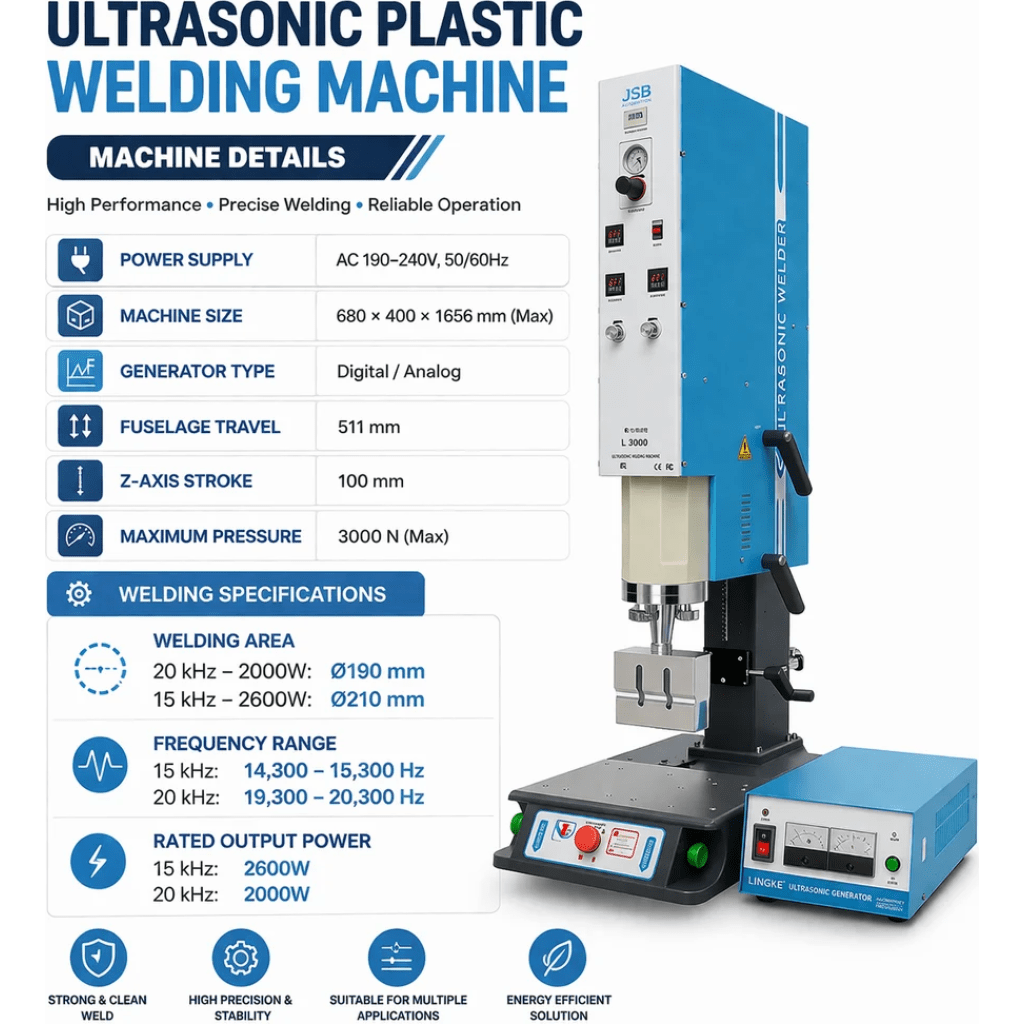
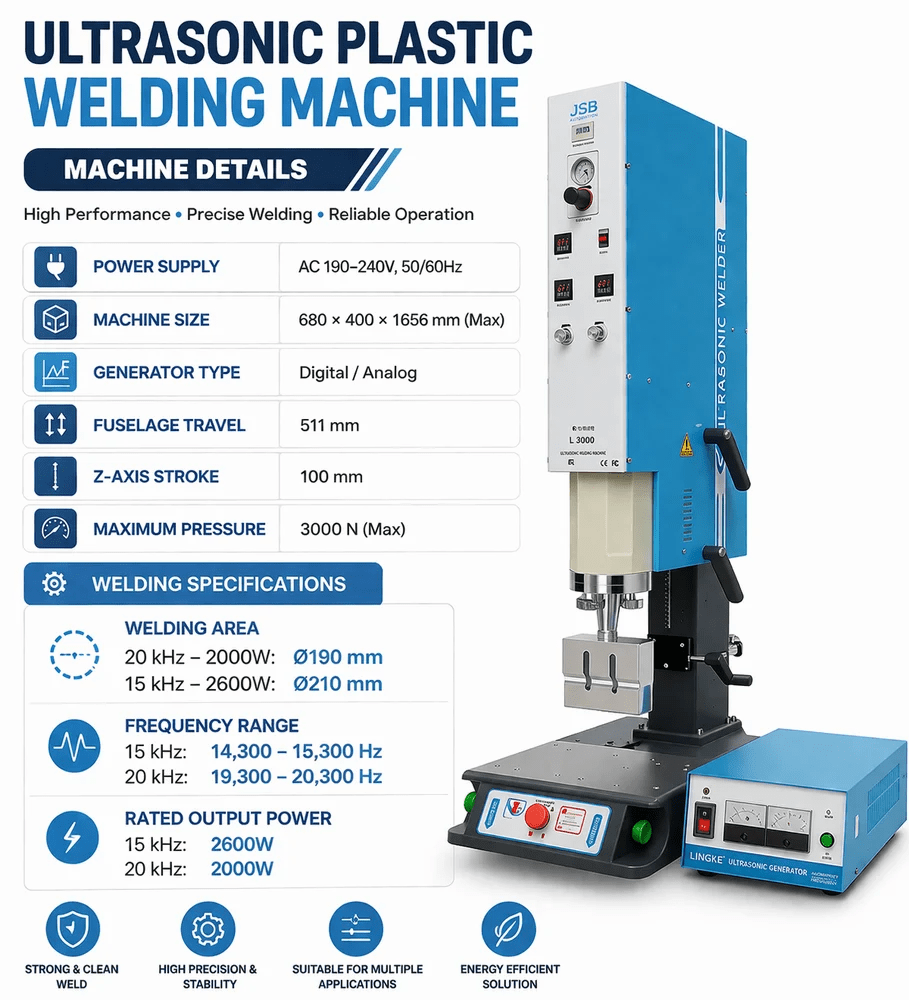
As one example, JSB’s Ultrasonic Plastic Welding Machine In Bawana is listed with a 15 kHz frequency, 2600 W power, manual automation grade and energy-mode welding. It is specified for materials including nylon, PP, ABS, PE, PC and acrylic, with applications including toys, packaging, automotive parts, medical parts and electronics. These specifications should be matched to the actual assembly through a technical discussion and trial.
Select the welding mode and process controls
The machine should provide a control method that matches how the weld is defined and inspected. Depending on the equipment and application, a process may be controlled by time, energy, height, depth or another parameter combination.
- Time mode: The ultrasonic cycle runs for a defined period. It can be useful when the parts and operating conditions are stable, but the resulting weld should still be validated.
- Energy mode: The cycle is based on energy delivered to the weld. This can help define the process by an input target, although part variation and coupling still need to be considered.
- Height or depth control: The final position or collapse of the assembly is used as a process reference. This may be useful where the joint geometry gives a meaningful dimensional result.
Controls should be chosen around the quality characteristic that matters most. For example, a sealed enclosure may need confirmation of joint integrity, while a visible consumer component may place more emphasis on flash, marking and appearance. Ask how settings are adjusted, how operators identify an acceptable weld and what information is available for troubleshooting.
Give the horn and fixture equal importance
The horn transfers ultrasonic vibration to the part, so its face must contact the intended area without damaging nearby features. Its shape, contact surface, material and tuning are linked to the application. A horn designed for one component should not simply be assumed suitable for another component with a different weld path.
The fixture supports the lower part and maintains alignment during the cycle. It should resist movement while avoiding distortion of thin walls, clips, ribs or sealing features. Poor support can produce inconsistent welds even when the machine itself is correctly specified.
JSB provides custom horns and fixtures as part of its listed services. During evaluation, share part drawings, samples, material details and production requirements so the tooling approach can be considered with the machine. If the application changes later, confirm whether the existing horn and fixture remain appropriate.
Decide between manual, semi-automatic and customised equipment
Automation grade should reflect the way parts arrive at the station and the amount of operator handling that is acceptable. A manual system may suit lower-volume work, development, varied parts or an operator-led loading process. A semi-automatic system may be suitable when repeatable loading, clamping or sequencing is required but the complete line is not automated.
For higher integration requirements, discuss the loading method, sensors, guarding, part orientation, cycle initiation and downstream inspection before choosing the machine. The goal is not to automate every movement; it is to create a stable and practical process that operators can run consistently.
JSB’s listed products include a 15 kHz, 1500 W semi-automatic ultrasonic plastic welding machine with power-mode welding, as well as application-specific machines and tooling options. The appropriate model depends on the customer part and process requirements rather than the automation label alone.
Use a sample trial as a selection checkpoint
A sample trial should answer practical questions before purchase:
- Can the required joint be formed without cracks, excessive flash, burn marks or unacceptable deformation?
- Does the horn contact the intended weld area evenly?
- Does the fixture hold the parts without damaging or distorting them?
- Can the process be adjusted to achieve repeatable results across representative samples?
- Are the cycle controls and operator steps suitable for the intended production station?
Bring parts that represent normal moulding variation, not only ideal samples. Define the acceptance criteria in advance, including appearance, strength, sealing or dimensional checks where relevant. Trial results are application-specific and should not be treated as a guarantee for a different part or material.
Consider installation and after-sales support
Machine selection should include the support required after the equipment reaches the factory. Confirm how installation will be handled, how operators will be introduced to the machine, and how questions about horns, fixtures, settings or spare parts will be addressed.
JSB Ultrasonic (JSB Automation) supplies and services Bawana customers with installation and after-sales service. Its listed services also include spare horns. Having the part information, tooling details and process observations available can make support discussions more useful when a weld changes during production.
A practical buying checklist for Bawana manufacturers
Before requesting a recommendation, prepare the following information:
- Part samples, drawings or clear photographs of the weld area.
- Material names and any known grades, fillers or surface treatments.
- Required weld function, such as joining, sealing, staking or assembly retention.
- Approximate production method and operator workflow.
- Preferred automation level and available floor-space considerations.
- Quality checks used to accept or reject the finished assembly.
- Questions about horn design, fixture support, installation and future spare horns.
For context on JSB’s local offering, visit the ultrasonic plastic welding machine supplier and manufacturer page for Bawana. The page can be reviewed alongside the technical information above when preparing an enquiry.
Frequently asked questions
Which ultrasonic welding machine is suitable for a Bawana factory?
There is no single model for every factory. The suitable machine depends on the plastic materials, joint design, weld area, part size, required controls, production method and tooling. A sample trial on the actual customer parts is the sensible way to narrow the choice.
Is a higher-wattage ultrasonic welding machine always better?
No. Power must be matched with frequency, horn design, fixture support, material and joint requirements. Excess capacity does not correct an unsuitable joint or poorly supported part.
Should I choose 15 kHz or 20 kHz?
Frequency selection depends on the application and tooling. Part size, material response, weld area, required amplitude and sensitivity to marking or deformation should all be considered. Compare both options with representative parts where appropriate.
Can JSB test my parts before I choose a machine?
Yes. JSB Ultrasonic (JSB Automation) lists sample trials on customer parts, along with custom horns and fixtures, installation and after-sales service. Share your parts and requirements when requesting an evaluation.
To discuss your parts, arrange a sample trial or review a machine requirement, contact JSB Ultrasonic (JSB Automation) in Bawana. You can also call +91 99581 18545 or +91 78000 62201, or email sales@jsbultrasonic.com.