October 28, 2026 · admin
JSB Ultrasonic (JSB Automation) is an ultrasonic plastic welding machine supplier in Okhla, serving manufacturers in Okhla Industrial Area from its base at N-76, DSIIDC Industrial Area, Sector 1, Bawana, New Delhi 110039. JSB supplies machines, delivers them to customers in Okhla, installs the equipment, conducts sample trials on customer parts and provides after-sales service.
For production engineers, plant owners and purchasing teams, selecting the right supplier involves more than comparing machine specifications. The welding process must suit the part design, plastic material, joint geometry, production method and quality requirements. JSB can discuss the application, evaluate customer parts through sample trials and recommend a suitable ultrasonic welding approach.
Ultrasonic welding support for Okhla manufacturers
Okhla Industrial Area includes varied manufacturing and assembly requirements. Plastic components may be used in electronics, automotive parts, packaging, medical products, toys and other industrial applications. Each application can require a different combination of frequency, power, welding mode, tooling and operator control.
JSB supports customers in Okhla with the following activities:
- Selection and supply of ultrasonic plastic welding machines
- Sample trials using the customer’s actual parts
- Custom horns and fixtures for the required joint and component geometry
- Machine installation at the customer’s facility
- After-sales service and application-related support
- Supply of spare horns when replacement tooling is required
This approach helps a buyer assess weld feasibility before finalising a machine configuration. A sample trial can also help identify issues related to part fit, energy transfer, flash, marking, incomplete welding or variation between components.
How ultrasonic plastic welding works
Ultrasonic welding joins compatible thermoplastic components by applying mechanical vibration at the joint. The parts are held together under pressure while a sonotrode or horn transfers high-frequency vibration into the assembly. The vibration produces localised heat at the contact area, allowing the plastic at the joint to soften and form a bond. After the vibration stops, holding pressure is maintained while the joint cools and stabilises.
The final result depends on the relationship between several process variables:
- Material: Resin type, grade, reinforcement, moisture condition and compatibility affect how the joint responds.
- Part design: Energy directors, joint profiles, wall thickness and alignment influence energy concentration and weld consistency.
- Tooling: The horn and fixture must support the part correctly and transfer vibration without unwanted movement.
- Process settings: Trigger force, welding pressure, amplitude, weld time, hold time and energy limits must be matched to the application.
- Machine configuration: Frequency, power capacity, control method and automation level should reflect the component and production target.
There is no universal setting that suits every plastic component. A process that works for one part may produce excessive marking, insufficient bonding or deformation on another. This is why testing customer parts is important when choosing an ultrasonic welding machine supplier in Okhla.
Choosing a machine for your Okhla production line
Start with the part and joint
Begin by defining what must be joined and where the weld is located. The supplier should understand the component’s dimensions, material combination, joint shape, visible surfaces and acceptable appearance. If the joint is difficult to access or the component is flexible, the fixture and horn design may be as important as the generator and press.
Confirm the plastic materials
Ultrasonic welding is generally suited to many thermoplastics, but weldability depends on the specific material pairing and part design. Materials with suitable compatibility and a well-designed joint can produce a reliable bond. Filled or reinforced plastics may behave differently from unfilled grades, and moisture-sensitive materials may require additional process attention.
For a broader explanation of material selection, see JSB’s guide to plastic materials suitable for ultrasonic welding. The guide can help your team prepare useful material information for a supplier discussion.
Match frequency and power to the application
Frequency and power should be selected according to the component size, joint area, material behaviour and required weld cycle. Smaller, delicate components may require a different approach from larger or more demanding assemblies. A higher power rating alone does not guarantee a better weld; the machine, horn, fixture and process parameters must work together.
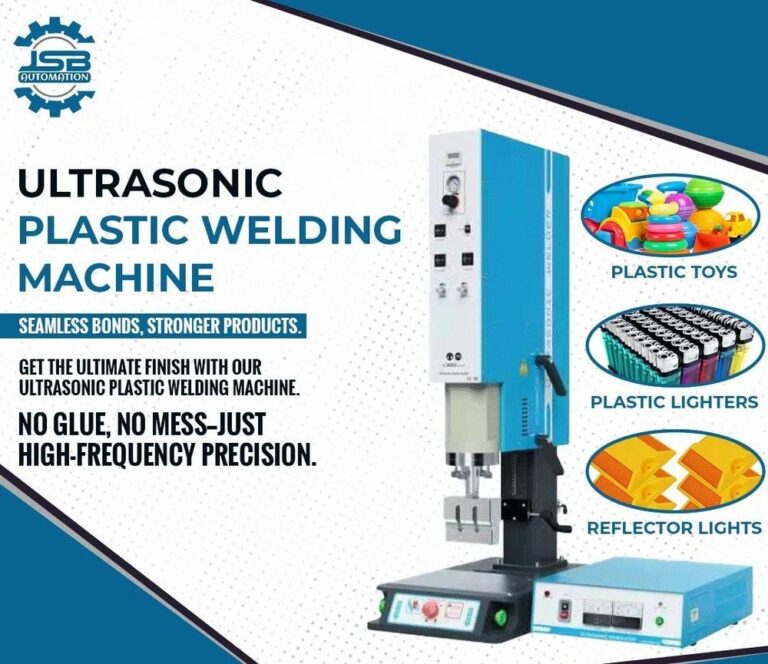
One relevant option is the Ultrasonic plastic welding machine in Okhla listed by JSB. Its listed specifications include 20 kHz frequency, 2000 W power, manual operation and time, depth, energy and power welding modes. The suitable configuration still depends on the actual part and trial results.
Consider control and production requirements
Discuss how the machine will be used on the shop floor. Important questions include whether the operation is manual or semi-automatic, how the operator will load the component, what inspection method will be used and which process limits need to be monitored. A production engineer should also consider fixture changeover, access for maintenance and the space available around the machine.
Buyers comparing suppliers can also review JSB’s guide to choosing the right ultrasonic welding machine. The decision should be based on the application rather than on frequency or power viewed in isolation.
Why sample trials matter before purchase
A sample trial provides practical information that a product brochure cannot provide. The trial can show whether the parts align correctly, whether the joint receives sufficient energy and whether the finished assembly meets the required visual and functional expectations. It can also reveal whether a custom horn or fixture is needed.
When sending parts for evaluation, provide representative components and, where possible, details about the plastic grade, dimensions, joint function, expected output and any visible-surface restrictions. If the assembly contains inserts, films, wires or other materials, include those in the trial because they can affect the welding process.
Trial observations should be recorded carefully. Useful checks may include joint integrity, component damage, flash, deformation, marking, dimensional change and repeatability across multiple samples. The correct acceptance criteria depend on the product’s function and your internal quality requirements.
Tooling, installation and after-sales service
The horn is the component that transfers vibration to the workpiece, while the fixture locates and supports the parts. Both should be designed around the component. A poorly supported part can move during welding, while an unsuitable horn can concentrate energy in the wrong area or create unwanted marks.
JSB provides custom horns and fixtures where the application requires them. Installation is also part of the supply process. During installation, the machine should be positioned correctly, connected according to the equipment requirements and checked with the intended tooling and parts. Operators should understand the loading method, basic controls, safe operation and routine checks.
After-sales service is important because welding performance can change when tooling, materials, part dimensions or production conditions change. JSB provides after-sales service and spare horns for customers who require replacement tooling. Maintenance planning should include inspection of the horn, fixture, fasteners, cables, pneumatic components where applicable and the general condition of the machine.
Working with JSB from Bawana, New Delhi
JSB Ultrasonic (JSB Automation) supplies and services customers in Okhla from Bawana, New Delhi. The company’s address is N-76, DSIIDC Industrial Area, Sector 1, Bawana, New Delhi 110039. Buyers can share part samples and application details for discussion before deciding on the machine type, tooling and process approach.
For a wider Delhi-focused overview, read JSB’s ultrasonic plastic welding machine supplier in Delhi page. This Okhla page remains focused on the practical points buyers should assess when selecting a supplier for their production requirement.
Frequently asked questions
Does JSB supply and service machines in Okhla?
Yes. JSB supplies and services machines for customers in Okhla, including machine delivery, installation, sample trials on customer parts and after-sales service, from its base in Bawana, New Delhi.
Can JSB test our plastic parts before we buy a machine?
Yes. JSB provides sample trials on customer parts. The trial can help assess weld feasibility and identify suitable tooling and process requirements for the application.
Can JSB provide a custom horn and fixture?
Yes. Custom horns and fixtures are among JSB’s services. The design depends on the component, joint geometry, material and loading arrangement.
How can we ask about ultrasonic welding machine pricing?
Pricing depends on the machine configuration, tooling, automation requirements and application. For general purchasing considerations, review JSB’s ultrasonic plastic welding machine price guide, then discuss the specific requirement with JSB.
To discuss your parts, arrange a sample trial or clarify a machine requirement for Okhla production, contact JSB Ultrasonic at +91 99581 18545 or sales@jsbultrasonic.com.