October 28, 2026 · admin
JSB Ultrasonic (JSB Automation) is an ultrasonic plastic welding machine supplier in Hyderabad, serving customers from its base at N-76, DSIIDC Industrial Area, Sector 1, Bawana, New Delhi 110039. JSB supplies machines to Hyderabad, provides delivery and installation support, conducts sample trials on customer parts, and offers after-sales service.
For production engineers, plant owners and buyers, the right supplier should provide more than a machine specification. The welding system must suit the component design, plastic materials, joint requirements, production method and tooling. JSB can discuss your application, evaluate customer parts through sample trials, and support the selection of a suitable ultrasonic plastic welding solution.
Choosing an ultrasonic plastic welding machine supplier in Hyderabad
Ultrasonic welding joins compatible thermoplastic components by applying mechanical vibrations at the joint while the parts are held under pressure. The vibration creates heat at the interface, allowing the material to soften and form a bond. After the vibration stops, holding pressure helps the joint consolidate as it cools.
The process can be clean and repeatable when the part design, material combination, horn, fixture and machine settings are properly matched. However, ultrasonic welding is not a universal setting-based process. A machine that works well for one component may require different frequency, power, amplitude, weld mode, tooling or clamp conditions for another.
When comparing suppliers, ask how they will address the complete application rather than only quoting a generator or press. A useful technical discussion should cover:
- The plastic materials and whether they are suitable for ultrasonic welding.
- The joint design, weld area, wall thickness and part tolerances.
- The required appearance, strength, sealing or containment performance.
- The expected production method, operator involvement and automation level.
- The horn and fixture arrangement needed to transfer energy consistently.
- The trial and installation support available after the machine is selected.
How JSB supports Hyderabad manufacturing requirements
JSB supplies and services customers in Hyderabad from Bawana, New Delhi. The support available for an application can include machine supply, delivery, installation, sample trials on customer parts, custom horns and fixtures, after-sales service and spare horns.
A sample trial is particularly useful when the joint has not yet been validated. The trial allows the welding approach to be considered against the actual component rather than relying only on general application descriptions. Parts can vary in resin, geometry, surface condition, weld area and tolerance, so the process should be assessed with the intended components whenever possible.
For a broader explanation of machine selection and requirement planning, see JSB’s Hyderabad manufacturer guide. This supplier page focuses on the practical questions to ask before choosing a machine partner.
Technical points to review before selecting a machine
Material compatibility
Ultrasonic welding is generally used for thermoplastic parts, but material compatibility depends on the resin combination, grade, fillers, moisture condition and part design. Similar materials often provide a more straightforward welding route, while dissimilar combinations need closer evaluation.
Materials listed for JSB’s Ultrasonic Plastic Welding Machine include acrylic, PC, PP, PVC, PE, nylon and ABS. These materials should not be treated as a guarantee that every part made from them will weld successfully. The component geometry and joint design still determine whether the application is suitable.
Joint design and energy direction
The joint should provide a controlled location for energy to enter the interface. Common design considerations include an energy director, adequate support beneath the weld area, consistent contact surfaces and enough material for the intended joint. A broad or irregular interface can make energy distribution difficult.
The horn contacts the upper component and transfers vibration into the assembly. The fixture supports the lower component and prevents unwanted movement. If the part is flexible, poorly supported or incorrectly located, the result may include inconsistent welds, marking, flash or damage to the component.
Frequency and power
Frequency and power should be selected according to the component, weld area, material and production objective. Smaller or more detailed components may call for a different approach from larger assemblies with a broad weld perimeter. Power alone does not determine welding performance; the generator, transducer, booster, horn and mechanical structure must work together.
JSB’s product range includes machines described with 15 kHz, 20 kHz, 30 kHz, 35 kHz and 40 kHz options across relevant equipment. The correct choice should be made after reviewing the part and process rather than selecting a frequency only because it appears in a catalogue.
Welding mode and process control
Ultrasonic systems may use time, energy, height or power-related control approaches, depending on the machine and application. Energy mode can help control the amount of energy delivered, while time mode controls the duration of vibration. Height or collapse-related control can be useful when the joint design and dimensional requirements make displacement important.
The best control method depends on what must be held consistently: weld time, delivered energy, collapse, final position or another process condition. A supplier should be able to explain which variables are relevant to the part and how the proposed machine will be set up.
Tooling: horns and fixtures are part of the solution
The horn is not a generic accessory. Its working face must match the component, contact the intended area and transfer vibration without creating unnecessary stress. Horn material, profile, contact area and mounting arrangement all affect the process.
The fixture is equally important. It should locate the parts repeatably, support the weld zone and allow the assembly to withstand clamping force. A fixture that permits rocking or distortion can make a capable welding machine appear inconsistent.
JSB provides custom horns and fixtures for applications where standard tooling is not appropriate. Customers should share component drawings, samples, material details, weld requirements and any known production constraints when discussing tooling. This gives the supplier useful information for evaluating the application.
Applications and machine selection
Ultrasonic plastic welding may be considered for assemblies used in packaging, electronics, automotive parts, medical parts, toys and other manufactured products. The process is useful when the component requires a controlled local joint and the selected materials and geometry support ultrasonic welding.
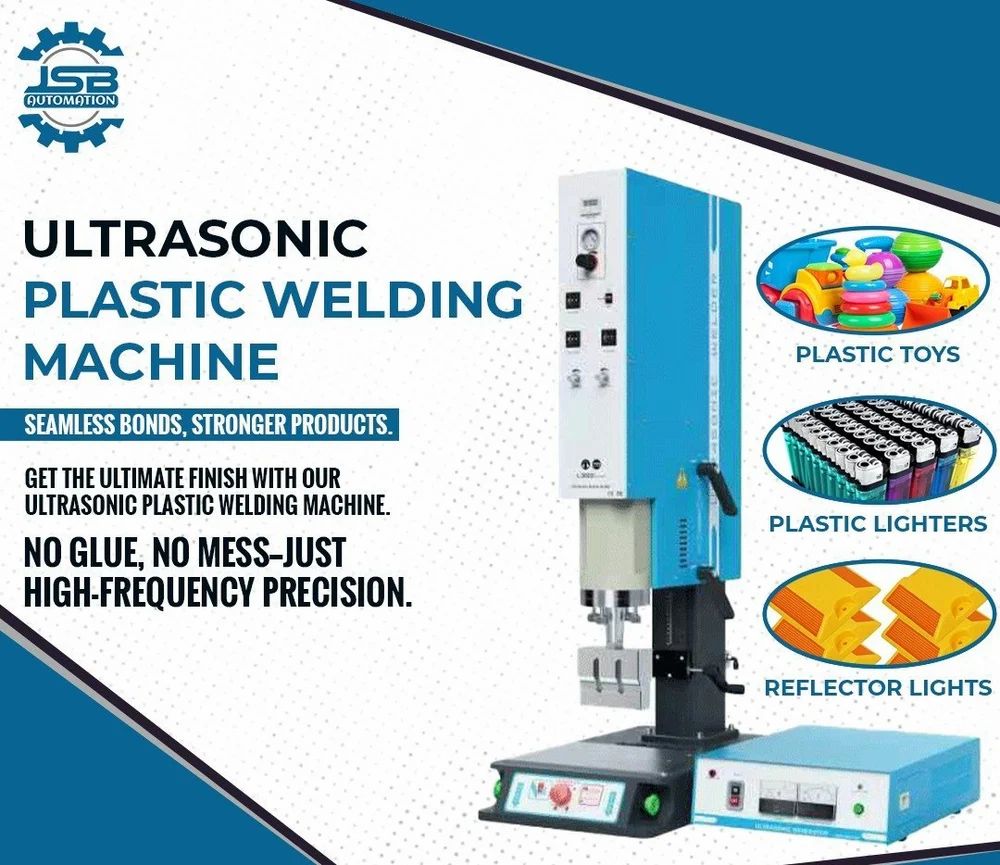
JSB’s Ultrasonic Plastic Welding Machine is listed as a 15 kHz, 1500 W, semi-automatic machine with power mode. It is listed for plastic welding and includes several thermoplastic material options. The suitability of this or another machine must be confirmed against the customer’s actual parts.
For applications requiring a more specific arrangement, JSB also lists the Custom Tooling Ultrasonic Welder for LED Wall Light Production. Its listed specifications include 15 kHz, 2600 W and semi-automatic operation. The product name indicates a custom-tooling application; it should not be assumed to suit another component without a technical review and trial.
What to prepare before contacting a supplier
A complete initial enquiry helps the supplier understand the requirement and identify the right next step. Include as many of the following details as possible:
- Part photographs, drawings or sample components.
- Material names, grades and any fillers or inserts.
- The joint location and the required weld function.
- Target production quantity and the current assembly method, if applicable.
- Any concerns about flash, marking, leakage, strength or appearance.
- Preferred automation level and available shop-floor space.
- Whether custom horns, fixtures or spare tooling will be required.
It is also useful to explain what constitutes an acceptable weld. “Strong” can mean different things depending on the product: resistance to separation, a sealed enclosure, dimensional retention, visual appearance or repeatable assembly. Clear acceptance criteria make sample evaluation more meaningful.
Installation and after-sales considerations
Installation involves more than positioning the machine. The machine needs suitable supporting equipment, correct tooling alignment, safe operation and a process setup that matches the component. Operators should understand how to load parts, position the fixture, start the cycle and identify an abnormal result.
After-sales support matters because tooling can wear, parts can change and process conditions may need review. JSB provides after-sales service and spare horns. Buyers should discuss the expected maintenance approach, tooling requirements and support process before finalising the machine selection.
For maintenance planning, the ultrasonic welding machine maintenance checklist provides related guidance. Preventive attention to the horn, fixture, fasteners, interfaces and general machine condition can help maintain process consistency, although the exact maintenance requirements depend on the equipment and application.
Frequently asked questions
Does JSB supply and service machines in Hyderabad?
Yes. JSB supplies and services customers in Hyderabad from Bawana, New Delhi. Support includes machine supply, delivery, installation, sample trials on customer parts and after-sales service.
Can JSB conduct a sample trial on our plastic parts?
Yes. JSB provides sample trials on customer parts. Share the component samples or relevant drawings, material information and weld requirements so the application can be discussed properly.
Can JSB provide custom horns and fixtures?
Yes. Custom horns and fixtures are among JSB’s services. The tooling requirement depends on the part geometry, weld area, material and fixture support needed for the application.
How should we ask for a machine recommendation?
Send the part details, materials, joint requirements, production expectations and any quality concerns to JSB. The team can then discuss the machine, tooling, installation and trial requirements. For pricing-related planning, see the ultrasonic plastic welding machine price guide.
To discuss your parts, arrange a sample trial or review a machine requirement for Hyderabad, contact JSB Ultrasonic (JSB Automation) at +91 99581 18545 or sales@jsbultrasonic.com.