October 28, 2026 · admin
JSB Ultrasonic (JSB Automation) is an ultrasonic plastic welding machine supplier in Bengaluru, supplying and servicing customers in Bengaluru, Karnataka from its base in Bawana, New Delhi. JSB supports machine supply, delivery, installation, sample trials on customer parts and after-sales service. The right machine is selected around the plastic, joint design, production method and quality requirements of the part.
For production engineers, plant owners and buyers, supplier selection should go beyond machine frequency or electrical power. A useful evaluation includes part trials, horn and fixture planning, weld control, operator use, installation and continued technical support. This guide explains what to review when sourcing an ultrasonic plastic welding machine for a Bengaluru manufacturing operation.
What an ultrasonic plastic welding machine does
Ultrasonic plastic welding joins compatible thermoplastic components by applying mechanical vibration at the joint while the parts are held under pressure. The vibration is transferred through a horn, also called a sonotrode. At the joint interface, the designed contact features soften through localized energy and pressure, allowing the components to form a bond when the cycle is completed.
The process is commonly used where a repeatable assembly is required without adding screws, adhesives or separate joining materials. Suitable applications depend on the part geometry, resin combination, joint design and required strength. Plastic components used in automotive parts, packaging, medical parts, toys and electronics may require different tooling and process settings.
An ultrasonic system generally brings together a generator, transducer, booster, horn, press or actuator and part fixture. These elements must work as a process rather than as isolated components. A horn that is unsuitable for the contact area, a fixture that allows movement or a joint that has no suitable energy-directing feature can affect weld consistency even when the machine itself is correctly specified.
Choosing a supplier for Bengaluru production
Begin with the component and joint
Share the actual component or representative samples with the supplier before finalizing a machine. The supplier should review the weld location, wall thickness, access for the horn, component tolerances and the way the finished assembly will be inspected. Joint design is especially important. A correctly designed energy director or a suitable shear joint can help concentrate the welding action where it is required.
Also identify the purpose of the weld. A housing that needs a closed seam may require a different approach from a component that needs staking, spot welding or assembly of a smaller insert. The expected appearance, leak resistance, pull strength, dimensional control and cycle repeatability should be discussed during the technical review.
Match frequency and power to the application
Frequency and power should be selected according to the part, material, weld area, tooling and process objective. A lower-frequency system may be considered for larger weld areas or applications needing greater amplitude capability, while higher-frequency systems may suit smaller or more detailed components. This is not a universal rule; the part and tooling must be evaluated together.
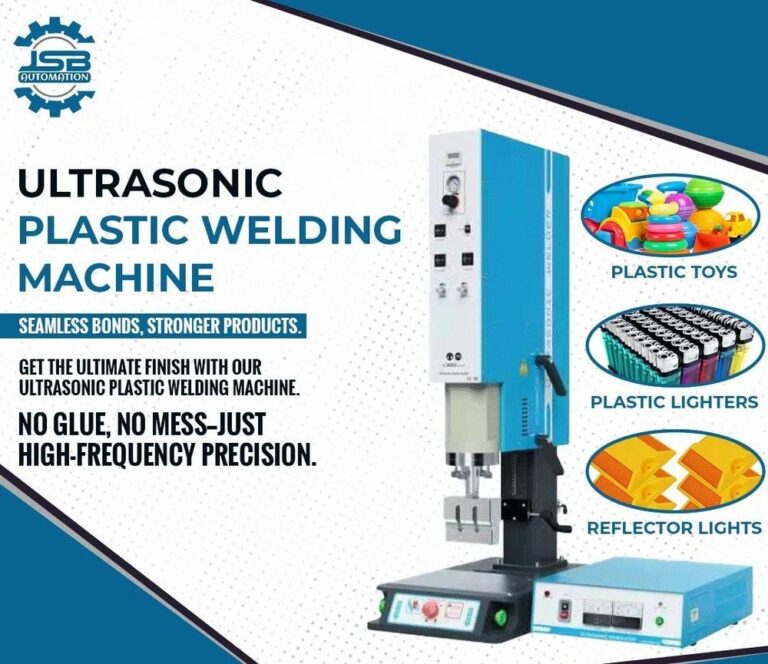
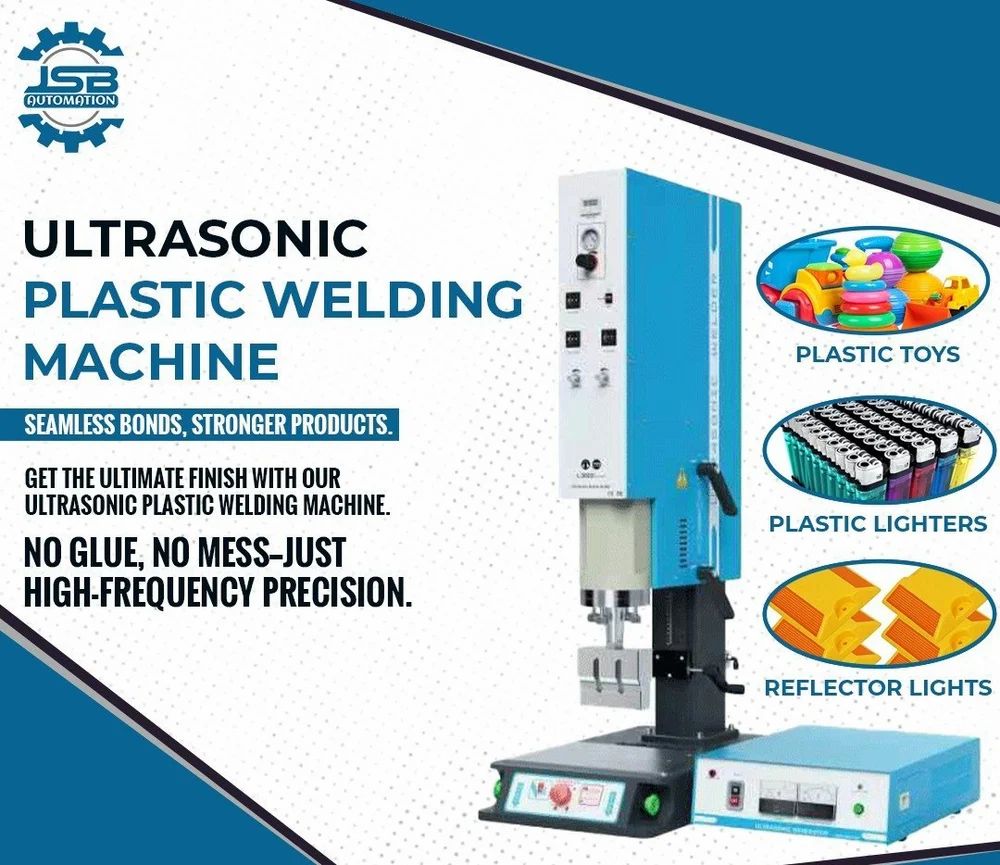
For example, JSB’s Ultrasonic Plastic Welding Machine is listed with a 15 kHz frequency, 1500 W power, semi-automatic operation and power-mode welding. It is specified for materials including acrylic, PC, PP, PVC, PE, nylon and ABS. These details describe that product; the appropriate configuration for a Bengaluru production line should be confirmed through the actual part and sample trial.
Review the welding mode and controls
Weld control can be based on variables such as time, energy, distance, height or a combination of process settings, depending on the machine configuration. Time mode can be useful when the process is already well established, while energy or position-related controls may help when the application needs closer monitoring of the joining event. The correct choice depends on the part and the way quality is verified.
Ask how operators will load the component, start the cycle, remove the finished part and identify an incomplete weld. Controls should be practical for the production environment. The supplier should also explain which settings can be adjusted, which tooling elements are application-specific and how the process will be checked after installation.
Why sample trials matter before purchase
A sample trial on customer parts is one of the most useful steps in selecting an ultrasonic welding machine. It allows the welding approach to be assessed on the actual material, geometry and joint. A trial can help identify whether the horn can reach the weld area, whether the fixture supports the components correctly and whether the selected welding mode is suitable for the required result.
During a trial, the engineering team should review more than whether two parts appear to join. Useful observations may include:
- Joint appearance and flash control.
- Part alignment before and after welding.
- Strength or functional requirements defined by the buyer.
- Effect of weld settings on the component surface.
- Repeatability across representative samples.
- Loading, unloading and inspection steps for the operator.
Trial results should be judged against the part’s actual acceptance criteria. A setting that works on one resin, wall thickness or joint design should not automatically be transferred to another component.
Tooling, horns and fixtures for plastic welding
The horn transfers ultrasonic energy to the component, so its contact face must match the weld area and part geometry. The fixture supports the lower component and prevents unwanted movement during the cycle. Both are central to the process. JSB provides custom horns and fixtures as part of its listed services, allowing the tooling discussion to begin with the customer’s component rather than with a generic machine description.
When reviewing tooling, discuss the following points:
- Available space around the weld and horn access.
- Contact surface and component support areas.
- Parting lines, ribs, bosses and delicate features.
- Changeover requirements for different components.
- Expected wear points and spare tooling requirements.
Tooling design may also influence cosmetic results. If the horn contacts a visible surface, the contact pattern and support arrangement need careful review. For repeat production, fixture location and part seating should make the loading process consistent.
Installation and after-sales support in Bengaluru
JSB supplies and services customers in Bengaluru from Bawana, New Delhi. The support scope includes delivery, installation, sample trials on customer parts and after-sales service. Installation should cover machine positioning, tooling fitment, basic operation and an initial review of the selected process settings.
Before installation, the buyer should prepare the required production space, electrical connection and component samples. The supplier can then focus on fitting the system to the application and explaining normal operation. It is also useful to clarify how spare horns and other service requirements will be handled. JSB supplies spare horns, which may be relevant when a production line uses application-specific tooling.
For an additional Bengaluru-focused reference, see JSB’s Ultrasonic Welding Machine in Bangalore page. The buying decision should still be based on the customer’s own parts, production objectives and trial findings.
Questions to ask before placing an order
A clear technical discussion helps prevent an unsuitable machine selection. Buyers can prepare the following information:
- What are the plastic materials and are they compatible at the proposed joint?
- What are the component dimensions, weld length and available horn access?
- Is the joint structural, cosmetic, sealing-related or intended for another function?
- What manual, semi-automatic or integrated production method is required?
- Which acceptance checks will be used for the finished assembly?
- Are custom horns, fixtures or spare horns required?
- Will the supplier conduct a sample trial on production parts?
- What installation and after-sales support will be available after supply?
Buyers comparing overall investment can also review JSB’s guide to choosing the right ultrasonic welding machine. For budget planning, the ultrasonic plastic welding machine price guide explains why pricing depends on machine configuration, tooling and application requirements.
Why work with JSB for a Bengaluru requirement?
JSB Ultrasonic (JSB Automation) is a manufacturer and supplier of ultrasonic plastic welding machines. Its service offering includes sample trials on customer parts, custom horns and fixtures, installation, after-sales service and spare horns. For a Bengaluru requirement, this creates a single technical discussion covering the machine, tooling and application rather than treating the equipment purchase separately from the joining process.
The most suitable machine should be confirmed after reviewing the component and, where appropriate, conducting a sample trial. This approach helps production teams make a decision based on weld performance, operator use and tooling suitability instead of selecting only by a catalogue specification.
Frequently asked questions
Does JSB supply and service machines in Bengaluru?
Yes. JSB supplies and services machines in Bengaluru, including machine supply, delivery, installation, sample trials on customer parts and after-sales service, from its base in Bawana, New Delhi.
Can JSB conduct a sample trial on our plastic parts?
Yes. Sample trials on customer parts are part of JSB’s services. The trial can help assess the material, joint design, horn access, fixture support and suitable process approach before the machine configuration is finalized.
Does JSB provide custom horns and fixtures?
Yes. JSB provides custom horns and fixtures. Their design depends on the component geometry, weld location, material, access and production requirements.
How should we ask about machine pricing?
Pricing depends on the required machine configuration, tooling and application. Buyers can review the price guide and then share their part details with JSB for an application-based discussion.
To discuss your Bengaluru parts, arrange a sample trial or review a machine requirement, contact JSB Ultrasonic (JSB Automation).