October 28, 2026 · admin
JSB Ultrasonic (JSB Automation) is an ultrasonic plastic welding machine supplier in Ambala, serving customers from its base at N-76, DSIIDC Industrial Area, Sector 1, Bawana, New Delhi 110039. JSB supplies machines, arranges delivery, installs the equipment, conducts sample trials on customer parts and provides after-sales service for customers in Ambala, Haryana.
For a production engineer, plant owner or buyer, the right machine depends on the plastic material, joint design, part size, production volume and required weld quality. JSB can discuss the application, review customer parts and help identify a suitable ultrasonic welding approach before the machine requirement is finalised.
Ultrasonic plastic welding support for Ambala manufacturers
Ultrasonic welding joins compatible thermoplastic components by converting high-frequency electrical energy into mechanical vibration. The vibration is transferred through a sonotrode, commonly called a horn, to the joint area while the parts are held under pressure. Heat is generated locally at the joint interface, allowing the plastic to soften and form a bond without adding adhesive or external filler material.
This process can be useful where a repeatable joint, clean appearance and controlled cycle are important. The actual result depends on the resin, part geometry, joint design, clamping, horn profile, welding mode and process settings. A machine should therefore be selected around the part and process rather than only by frequency or power rating.
Manufacturers in Ambala evaluating plastic assembly equipment can discuss applications such as plastic housings, covers, packaging components, electronic parts, automotive parts, medical-related plastic components and toys. These are application examples, not a substitute for a trial: weldability must be checked on the actual material and component design.
How JSB helps with a machine requirement
Application discussion and part review
The first step is to understand what must be joined and what the finished assembly must achieve. Useful information includes the plastic grades, component dimensions, joint location, visible surfaces, weld-line requirements, output expectations and any leak, pull or appearance requirements. Photos, drawings or sample parts can help make the initial discussion more practical.
Material compatibility is important. Common thermoplastics used with ultrasonic welding include PP, ABS, PE, nylon, acrylic, PC and PVC, but the specific grade, additives, moisture condition and part design can affect the result. JSB lists these materials as suitable on relevant machine applications, while the final process should be verified through trials on the customer’s parts.
Sample trials on customer parts
JSB provides sample trials on customer parts. A trial helps assess whether the proposed horn contact, fixture support and process settings are appropriate for the component. It can also help identify design changes before production equipment is ordered.
During application development, the key observations may include joint formation, flash, cosmetic marking, part movement, dimensional change and consistency between samples. Depending on the application, the welding mode may be based on time, energy, power, height or another controlled process variable available on the selected equipment. The appropriate mode depends on the part and the required control.
Custom horns and fixtures
The horn transfers vibration to the welding area, so its contact surface must suit the component. A fixture supports the lower part and helps maintain alignment during the weld. Poor support can allow movement or absorb energy in the wrong place; excessive or uneven contact can mark the part or affect the joint.
JSB offers custom horns and fixtures for applications that require application-specific tooling. Tooling design should consider the weld path, clearances, part support, surface finish and access for loading and unloading. For complex components, these details are often as important as the generator and actuator selection.
Machine considerations for plastic welding
Frequency and power
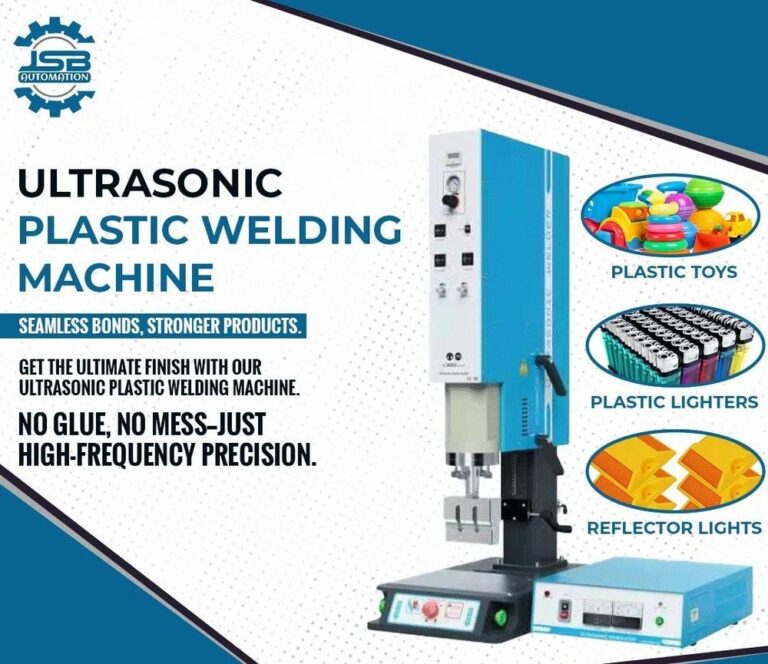
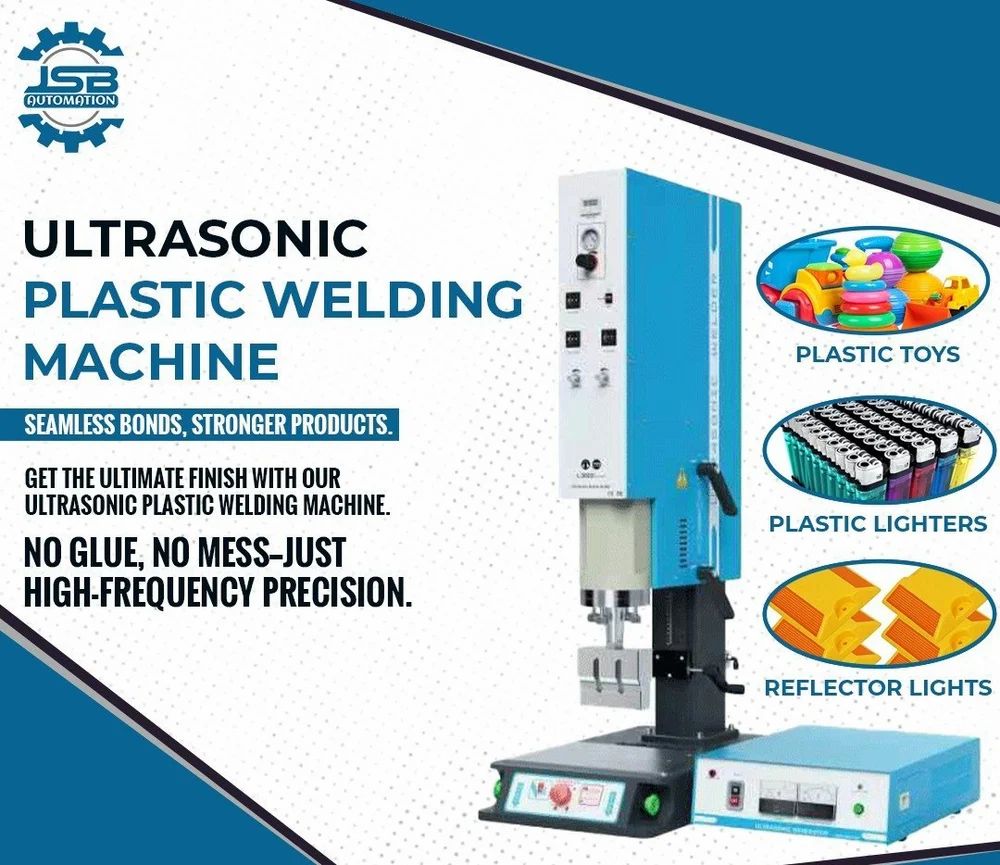
JSB supplies ultrasonic plastic welding machines with different configurations. One listed Ultrasonic Plastic Welding Machine has a 15 kHz frequency, 1500 W power, semi-automatic operation and power mode. Its listed suitable materials include acrylic, PC, PP, PVC, PE, nylon and ABS.
Another application listing, the Ultrasonic Plastic Welding Machine Supplier In Shamli machine page, describes a 15 kHz, 2600 power manual machine with energy mode and applications including automotive parts, packaging, medical parts, toys and electronics. The specification that suits one part may not suit another. Frequency and power should be considered alongside joint area, material stiffness, weld depth and the tooling arrangement.
Manual and semi-automatic operation
Manual equipment may be suitable when an operator loads and unloads individual parts or when production requirements call for a straightforward setup. Semi-automatic equipment can be considered when the application needs a more structured operating sequence or improved repeatability. The choice depends on the part presentation, cycle requirements, operator involvement and level of automation needed.
Welding mode and process control
Time, energy, power and height modes control different aspects of the welding cycle. Time mode controls vibration duration, while energy mode monitors the energy delivered during the cycle. Height-based control can help where a defined collapse or movement is relevant. The most useful mode depends on the joint design and the quality characteristics that need to be controlled.
Process settings should be developed through controlled trials. Increasing amplitude or pressure without checking the part can create flash, stress or cosmetic damage. Reducing energy too far can leave an incomplete joint. A stable process normally requires consistent part positioning, clean contact surfaces, suitable fixture support and a repeatable loading method.
Applications to evaluate with an Ambala production team
Ultrasonic plastic welding can be evaluated for assemblies where two compatible thermoplastic parts need to be joined without conventional fasteners or liquid adhesive. Potential application groups include housings, small plastic assemblies, packaging items, electronic components, automotive plastic parts, laboratory-related components and consumer products.
The part must be designed with ultrasonic welding in mind. Features such as an energy director, a suitable joint interface and adequate support can make energy transfer more predictable. Wall thickness, ribs, bosses and nearby delicate features also influence the process. If the current part was designed for another joining method, a tooling or joint redesign may be needed.
For background on material selection, see JSB’s guide to plastic materials suitable for ultrasonic welding. For a broader application view, the article on ultrasonic plastic welding applications in automotive and electronics may also be useful.
Installation and after-sales service in Ambala
JSB supplies and services customers in Ambala from Bawana, New Delhi. The support includes machine delivery, installation, sample trials on customer parts and after-sales service. Installation should cover equipment placement, electrical and pneumatic requirements where applicable, tooling fitment, operating procedure and initial process checks.
After installation, operators should follow a consistent loading method and keep the horn and fixture contact areas clean. Routine checks can help identify loose tooling, alignment changes, unusual noise or variations in weld quality. JSB also supplies spare horns, which can be relevant when a tooling replacement or application change is required.
For a general overview of maintenance practices, read the ultrasonic welding machine maintenance checklist. Maintenance requirements vary with machine configuration, operating conditions and production use.
What to share when requesting a quotation or trial
To make a machine discussion more useful, an Ambala buyer can prepare:
- Sample parts or clear component drawings.
- Plastic material names and available grade information.
- Joint photographs or a description of the weld location.
- Required production quantity and operator loading method.
- Quality requirements such as appearance, strength or leak performance.
- Available electrical and shop-floor information.
These details help JSB assess whether a standard machine, custom horn and fixture, or a more application-specific arrangement should be considered. The ultrasonic plastic welding machine price guide can help buyers understand the factors that influence machine selection and overall equipment requirements.
Frequently asked questions
Does JSB supply and service machines in Ambala?
Yes. JSB supplies and services machines for customers in Ambala, including machine delivery, installation, sample trials on customer parts and after-sales service, from its base in Bawana, New Delhi.
Can JSB test our plastic parts before we select a machine?
Yes. JSB provides sample trials on customer parts. Share the component details and application requirement so the proposed welding process and tooling can be discussed.
Does JSB provide custom horns and fixtures?
Yes. JSB provides custom horns and fixtures for applications that require tooling designed around the part, joint and loading arrangement.
How can we contact JSB about an Ambala requirement?
Contact JSB Ultrasonic (JSB Automation) through the contact page, call +91 99581 18545 or +91 78000 62201, or email sales@jsbultrasonic.com.
Discuss your parts, a sample trial or a machine requirement with JSB Ultrasonic. The team can review the application and explain the next steps for supply, installation and support in Ambala.