Ultrasonic Plastic Welding Machine in Zimbabwe
Ultrasonic Plastic Welding Machine in Zimbabwe
JSB Ultrasonic supplies industrial
ultrasonic plastic welding machines in Zimbabwe for manufacturers
that require fast, precise and repeatable joining of compatible thermoplastic
components. Our ultrasonic welding solutions are suitable for automotive,
electrical, electronics, medical, packaging, consumer products, battery
components and general plastic manufacturing applications.
Our range includes 15kHz ultrasonic plastic welding machines,
20kHz ultrasonic plastic welding machines, high-power
ultrasonic welders, handheld ultrasonic welding equipment, customized welding
systems, ultrasonic horns, generators and other ultrasonic components.
For customers in Zimbabwe, machine selection can be based on the plastic
material, component dimensions, welding area, joint design, required weld
strength, production quantity and desired level of automation. JSB Ultrasonic
can provide application-focused solutions for standard as well as customized
plastic welding requirements.
Ultrasonic Plastic Welding Machine Supplier for Zimbabwe
Manufacturers working with thermoplastic components often need a joining process
that can provide consistent results while maintaining production efficiency.
Ultrasonic plastic welding uses high-frequency mechanical vibration and
controlled pressure to join suitable thermoplastic materials.
JSB Ultrasonic is an India-based manufacturer and supplier of ultrasonic
welding equipment. Our product range includes industrial plastic welding
machines, high-power ultrasonic systems, handheld welding equipment, customized
welding horns and related ultrasonic components.
You can explore the complete
ultrasonic welding machine product range
for different industrial applications.
What Is an Ultrasonic Plastic Welding Machine?
An ultrasonic plastic welding machine is an industrial joining system that
uses high-frequency mechanical vibration to bond compatible thermoplastic
components. The process applies controlled ultrasonic energy to a specially
designed joint between two plastic parts.
The ultrasonic generator supplies electrical energy to the transducer. The
transducer converts this energy into mechanical vibration. The vibration is
then transferred through the booster and ultrasonic horn to the product.
At the joint interface, controlled vibration generates localized heat. The
compatible thermoplastic surfaces soften and fuse together under pressure.
Once the ultrasonic energy stops, the components remain under pressure for a
controlled holding period so that the joint can stabilize.
This makes ultrasonic welding useful for repetitive manufacturing applications
where controlled and consistent plastic assembly is required.
Ultrasonic Plastic Welding Machines Available for Zimbabwe
Different products require different welding configurations. JSB Ultrasonic
offers multiple ultrasonic machine options for different component sizes,
materials and production requirements.
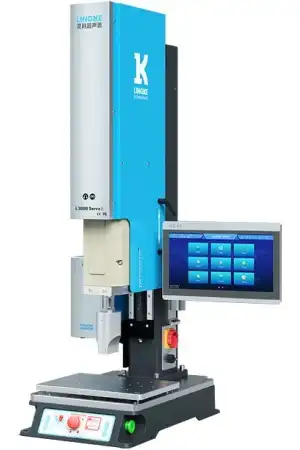
15kHz 2600W Ultrasonic Plastic Welding Machine
The
15kHz 2600W Ultrasonic Plastic Welding Machine
is a high-power industrial system designed for demanding thermoplastic
applications. The listed machine operates at 15kHz with 2600W power and is
designed for applications involving larger or more complex plastic components.
The machine is listed for applications including automotive plastic components,
electrical and electronic enclosures, medical assemblies, packaging, battery
cases and EV-related plastic components. :contentReference[oaicite:1]{index=1}
20kHz 2000W Ultrasonic Plastic Welding Machine
The
20kHz 2000W Ultrasonic Plastic Welding Machine
is designed for precision joining of compatible thermoplastic components.
The listed configuration provides 2000W ultrasonic power at 20kHz and is
described for automotive, electronics, medical, packaging, battery and other
plastic assembly applications. :contentReference[oaicite:2]{index=2}
20kHz Ultrasonic Plastic Welding Machine
The
20kHz Ultrasonic Plastic Welding Machine
is a high-frequency ultrasonic system for joining thermoplastic components.
The product is described as suitable for medium-sized plastic components and
applications in automotive, electronics, medical devices and packaging.
:contentReference[oaicite:3]{index=3}
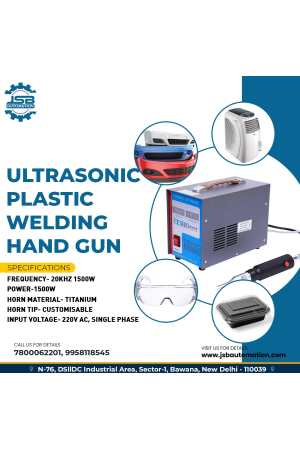
Ultrasonic Plastic Welding Handgun
For applications that require flexible manual operation, the
Ultrasonic Plastic Welding Handgun
provides a portable ultrasonic welding solution. The listed system is designed
for applications such as plastic sheets, filters, automotive components,
packaging, medical products and electronic housings. :contentReference[oaicite:4]{index=4}
Applications of Ultrasonic Plastic Welding in Zimbabwe
Ultrasonic plastic welding can be considered for many manufacturing applications
when the material combination and product design are suitable. It is particularly
useful where manufacturers need repeatable joining and controlled production
cycles.
Automotive Plastic Components
Automotive products use many thermoplastic housings, covers, interior parts,
filters, ducts and other moulded components. Suitable components can be evaluated
for ultrasonic welding when a repeatable and controlled joining process is
required.
Electrical and Electronics Manufacturing
Electrical enclosures, electronic housings, connectors, covers and other plastic
components can be suitable for ultrasonic welding. The process can provide a
controlled method for repetitive plastic assembly.
Medical Plastic Products
Suitable medical and healthcare components manufactured from compatible
thermoplastics can be evaluated for ultrasonic welding. Possible applications
include filters, catheter components, connectors, diagnostic products and
disposable medical assemblies.
JSB Ultrasonic offers an
Ultrasonic Plastic Welding Machine for the Medical Industry
.
The listed system is designed for applications including IV and blood filters,
catheter components, medical valves and tube connectors, test cartridge
housings and disposable medical products. :contentReference[oaicite:5]{index=5}
Plastic Packaging
Plastic containers, covers, packaging components and other suitable
thermoplastic products can be considered for ultrasonic joining. The process
can be useful where clean and repeatable assembly is important.
Battery and EV Components
Battery housings, covers and other plastic components used in battery and
electric-vehicle applications may be evaluated for ultrasonic welding.
Machine selection depends on the material, component geometry, welding area
and required joint performance.
Consumer Plastic Products
Household products, plastic housings, covers, containers and consumer components
can be considered for ultrasonic welding where the thermoplastic material and
joint design are compatible with the process.
Industrial Plastic Components
Industrial manufacturers can evaluate ultrasonic welding for plastic housings,
covers, filters, fittings, assemblies and other components where consistent
joining is required.
Plastic Files and Stationery
Ultrasonic welding can also be used for suitable plastic stationery products.
JSB Ultrasonic offers an
Ultrasonic Plastic Welding File Folder Machine
designed for bonding plastic sheets used in files, document folders and
stationery products. :contentReference[oaicite:6]{index=6}
Mobile Charger Plastic Housings
Plastic charger casings and related components can be suitable for ultrasonic
welding when the materials and joint design are appropriate. JSB Ultrasonic
offers an
Ultrasonic Plastic Welding Machine for Mobile Chargers
for charger casing and component assembly applications. :contentReference[oaicite:7]{index=7}
How Does Ultrasonic Plastic Welding Work?
-
Product positioning:
The plastic components are accurately positioned inside a suitable fixture. -
Clamping:
Controlled pressure holds the components in the required position. -
Ultrasonic activation:
The generator supplies the electrical signal to the ultrasonic transducer. -
Vibration conversion:
The transducer converts electrical energy into mechanical vibration. -
Energy transfer:
The booster and horn transfer the ultrasonic vibration to the welding area. -
Localized heating:
Controlled vibration generates localized heat at the joint interface. -
Plastic fusion:
The compatible thermoplastic surfaces soften and form the welded joint. -
Holding:
Pressure is maintained for a controlled period before the finished product
is released.
Which Plastic Materials Can Be Welded?
Ultrasonic welding is mainly used for compatible thermoplastic materials.
However, the actual welding performance depends on the exact material grade,
additives, component geometry, joint design and other application factors.
Depending on the application, materials such as
ABS, PP, PVC, PET, PC, PMMA and Nylon may be considered for
ultrasonic welding.
A material and sample evaluation is recommended before selecting the final
machine and tooling, particularly for new or complex products.
Benefits of Ultrasonic Plastic Welding
- Fast welding cycles for suitable applications
- Repeatable joining when welding parameters are correctly controlled
- Clean process without conventional adhesive application
- Reduced consumables for suitable applications
- Localized energy application at the designed joint
- Consistent production for repetitive manufacturing
- Automation compatibility for production-line integration
- Suitable for many thermoplastics
- Reduced assembly steps in suitable product designs
Ultrasonic Generator, Transducer, Booster and Horn
A complete ultrasonic welding system consists of multiple components that
work together to transfer ultrasonic energy to the product.
Ultrasonic Generator
The ultrasonic generator creates the electrical signal required to operate
the ultrasonic welding system. The generator must be correctly matched to
the frequency and transducer configuration.
JSB Ultrasonic also supplies
Ultrasonic Generator Boxes
for suitable ultrasonic welding systems.
Ultrasonic Transducer
The transducer converts electrical energy into mechanical vibration. The
transducer frequency must correspond to the ultrasonic welding system.
Ultrasonic Booster
The booster transfers vibration between the transducer and horn and can be
selected according to the required amplitude and system design.
Ultrasonic Welding Horn
The ultrasonic horn, also called a sonotrode, transfers mechanical vibration
to the workpiece. Horn geometry is selected according to the component shape,
welding profile and contact area.
JSB Ultrasonic supplies
Ultrasonic Plastic Welding Horns
for application-specific plastic welding requirements. :contentReference[oaicite:8]{index=8}
How to Select an Ultrasonic Plastic Welding Machine
Choosing the right ultrasonic welding machine requires consideration of the
complete application rather than only comparing frequency or machine price.
Plastic Material
Identify the exact plastic material and grade being joined. Material
compatibility is one of the most important factors in ultrasonic welding.
Component Dimensions
Product size, wall thickness and geometry can influence machine power, horn
design and fixture requirements.
Welding Area
The size and shape of the welding area determine how ultrasonic energy should
be transferred to the component.
Joint Design
A suitable ultrasonic joint design helps concentrate vibration at the intended
welding interface.
Required Weld Strength
The required mechanical strength, sealing performance and visual finish should
be considered before selecting the machine.
Production Quantity
Handheld, manual, semi-automatic and automatic systems can be selected according
to production volume and manufacturing workflow.
Automation Requirements
High-volume production may require pneumatic clamping, automatic loading,
multiple welding stations or integration with an existing production line.
Customized Ultrasonic Plastic Welding Machines for Zimbabwe
Some products require specialized ultrasonic tooling because of their shape,
dimensions, welding profile or number of welding points. In such applications,
a customized ultrasonic welding system may provide a better solution than a
standard machine.
JSB Ultrasonic can provide application-oriented solutions including:
- Customized ultrasonic horns
- Product-specific welding fixtures
- Pneumatic clamping systems
- Multiple welding-point arrangements
- Semi-automatic ultrasonic welding machines
- Automatic ultrasonic welding systems
- Special-purpose plastic welding machines
- Production automation integration
Ultrasonic Plastic Welding Machine Price in Zimbabwe
The ultrasonic plastic welding machine price in Zimbabwe
depends on the machine frequency, ultrasonic power, welding area, horn design,
fixture, control system, pneumatic system and automation requirements.
A standard manual or semi-automatic machine has different requirements from
a customized automatic welding system. Special horns, product fixtures and
automation can also affect the total project cost.
For an accurate quotation, manufacturers should provide the plastic material,
component dimensions, welding area, required weld strength, production quantity
and desired automation level.
JSB Ultrasonic can evaluate these requirements and recommend a suitable machine
configuration for the intended application.
Why Choose JSB Ultrasonic?
- Industrial ultrasonic welding solutions
- 15kHz and 20kHz machine configurations
- High-power plastic welding machines
- Customized ultrasonic welding solutions
- Application-specific horns and fixtures
- Ultrasonic generators and related components
- Handheld ultrasonic welding equipment
- Medical plastic welding solutions
- Special-purpose welding machines
- Technical assistance for machine selection
- Solutions for different thermoplastic applications
Popular Ultrasonic Welding Products
Explore selected ultrasonic welding machines and components available from
JSB Ultrasonic:
-
15kHz 2600W Ultrasonic Plastic Welding Machine
-
20kHz 2000W Ultrasonic Plastic Welding Machine
-
20kHz Ultrasonic Plastic Welding Machine
-
Ultrasonic Plastic Welding Handgun
-
Ultrasonic Plastic Welding Machine for Medical Industry
-
Ultrasonic Plastic Welding Machine for Mobile Chargers
-
Ultrasonic Plastic Welding File Folder Machine
-
Ultrasonic Plastic Welding Horn
-
Ultrasonic Generator Box
Industries That Can Use Ultrasonic Plastic Welding
Depending on material compatibility and product design, ultrasonic welding can
be evaluated for a wide range of industries.
- Automotive manufacturing
- Electrical products
- Electronic components
- Medical and healthcare products
- Plastic packaging
- Battery and EV components
- Consumer products
- Industrial equipment
- Plastic stationery
- Mobile charger components
- Filters and plastic assemblies
Get an Ultrasonic Plastic Welding Machine for Zimbabwe
If you are searching for an
ultrasonic plastic welding machine in Zimbabwe, contact
JSB Ultrasonic with your product and production details.
For machine selection, provide the plastic material, component dimensions,
welding area, joint design, required weld strength, production quantity and
number of welding points.
Product photographs, technical drawings or samples can also help determine
the appropriate ultrasonic horn, fixture and machine configuration.
JSB Ultrasonic provides ultrasonic plastic welding machines, ultrasonic
generators, transducers, boosters, horns, handheld welding systems and
customized ultrasonic welding solutions for industrial applications.
Frequently Asked Questions
Does JSB Ultrasonic supply ultrasonic welding machines to Zimbabwe?
JSB Ultrasonic supplies ultrasonic welding equipment from India for industrial
applications. Customers can contact the company with their product requirements
to discuss the appropriate machine configuration and delivery requirements for
Zimbabwe.
Which ultrasonic plastic welding machines are available?
JSB Ultrasonic offers 15kHz and 20kHz ultrasonic plastic welding machines,
high-power systems, handheld welding equipment and customized ultrasonic
welding solutions.
What is the difference between 15kHz and 20kHz ultrasonic welding?
The appropriate frequency depends on the component size, material, welding
area, joint design and production requirements. A 15kHz system may be
considered for larger or more demanding components, while 20kHz systems are
widely used for many industrial plastic joining applications.
Which plastic materials can be welded using ultrasonic welding?
Compatible thermoplastics such as ABS, PP, PVC, PET, PC, PMMA and Nylon may
be considered for ultrasonic welding. Actual weldability depends on the
specific material grade, component geometry and joint design.
What factors affect ultrasonic plastic welding machine price?
Frequency, ultrasonic power, welding area, horn design, fixture, control
system, pneumatic arrangement and automation requirements can affect the
overall machine configuration and price.
Can ultrasonic welding be used for medical plastic products?
Yes. Suitable medical-grade thermoplastic components can be evaluated for
ultrasonic welding. JSB Ultrasonic offers a medical ultrasonic plastic welding
machine for applications including filters, catheter components, connectors
and disposable medical products.
Can JSB Ultrasonic manufacture customized ultrasonic horns?
Yes. Customized ultrasonic horns can be designed according to the product
geometry, welding profile, contact area, material and machine frequency.
Can ultrasonic plastic welding machines be automated?
Yes. Depending on the application, ultrasonic welding systems can be configured
with pneumatic clamping, automatic product handling, multiple welding stations
and production-line automation.
What information is needed for an ultrasonic welding machine quotation?
Useful information includes the plastic material, product dimensions, welding
area, joint type, required weld strength, production quantity and desired
automation level. Product samples, photographs or technical drawings can help
with machine and horn selection.
Showing all 10 results
-

15kHz 2600W Ultrasonic Welding Transducer
₹15000.00 Add to cart -
Sale!

Elastic Ribbon Cutting Machine
Original price was: ₹35000.00.₹30000.00Current price is: ₹30000.00. Add to cart -
Sale!
Hot and Cold Cutting Machine with Marking Sensor
Original price was: ₹95000.00.₹90000.00Current price is: ₹90000.00. Add to cart -

Pneumatic Ultrasonic Spot Welding Machine
₹46000.00 Add to cart -

Powerful Ultrasonic Sewing Machine
₹70000.00 Add to cart -
Ultrasonic Plastic Welding Handgun
₹95000.00 Add to cart -
Sale!

Ultrasonic Plastic Welding Horn
Original price was: ₹16000.00.₹15000.00Current price is: ₹15000.00. Add to cart -
Sale!

Ultrasonic Plastic Welding Machine for the Medical Industry
Original price was: ₹300000.00.₹250000.00Current price is: ₹250000.00. Add to cart -
Sale!
Ultrasonic Plastic Welding Machine For Toys,Rattels,Water Game
Original price was: ₹220000.00.₹210000.00Current price is: ₹210000.00. Add to cart -
Sale!

Ultrasonic welding machine for mobile charger
Original price was: ₹170000.00.₹150000.00Current price is: ₹150000.00. Add to cart
