
Description
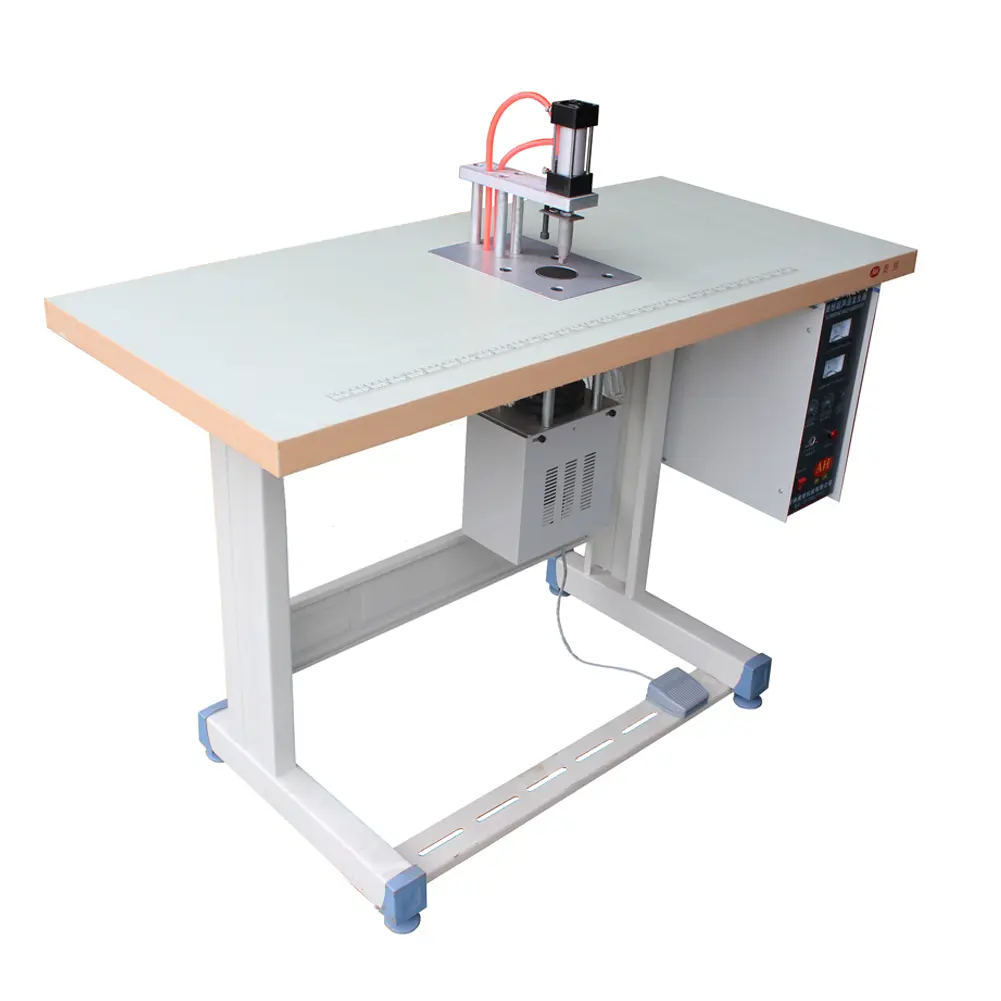
The Pneumatic Ultrasonic Spot Welding Machine is a cost-effective, compact solution for joining wires, foils, battery tabs, and other conductive components without solder, flux, or adhesives. Operating at 15kHz–20kHz, it produces strong, low-resistance solid-state welds suited to high-volume production.
As part of JSB Ultrasonic’s Ultrasonic Spot Welding Machine range, this machine is built for manufacturers who need consistent, repeatable metal joints — from EV battery tab welding to wire harness splicing and electrical connector assembly.
From pilot-line battery module builds to full-scale gigafactory-adjacent production, the same solid-state ultrasonic welding principle scales across production volumes, with configuration matched to your specific foil thickness and stack count.
How the Pneumatic Ultrasonic Spot Welding Machine Works
The machine clamps overlapping metal foils, tabs, or wires between an anvil and a vibrating horn. High-frequency vibration creates micro-scale friction at the interface, breaking down surface oxides and forming a true metallurgical solid-state bond — without melting the base metal, unlike resistance or laser welding.
Because the process is cold (no melt zone), it preserves the electrical and mechanical properties of thin foils and reliably joins multiple stacked layers to a single busbar or terminal — a common requirement in battery pack and wire harness assembly.
Key Applications
The Pneumatic Ultrasonic Spot Welding Machine is commonly used across the following applications:
- Battery tab & busbar welding — joining lithium-ion cell tabs to busbars in EV and energy-storage packs.
- Wire harness splicing — joining and terminating multi-strand wiring for automotive and industrial use.
- Electrical connector assembly — welding terminals and connectors for electronics manufacturing.
- Foil & thin-sheet joining — joining copper and aluminium foils in battery and electronics production.
- Motor & coil winding termination — welding fine wire terminations in motor and transformer assembly.
- Solar panel ribbon welding — joining conductive ribbons in solar module assembly.
- Battery module interconnects — joining modules together within a larger battery pack assembly.
- Sensor & PCB wire termination — welding fine wire connections in sensor and circuit assembly.
Real-World Examples
A battery module manufacturer scaling up production needed a way to join multiple thin copper cell tabs to a single busbar without the inconsistent resistance and micro-cracking they were seeing with resistance welding. Moving to ultrasonic metal welding delivered a consistently low-resistance, solid-state joint across thousands of welds per shift, while removing the flux and post-weld cleaning steps resistance welding had required.
An electronics manufacturer was hand-soldering wire terminations, which was slow and produced inconsistent joint quality across operators. Switching to ultrasonic metal welding standardized the joint process, cut per-unit termination time significantly, and removed flux residue concerns from their downstream cleaning process.
Choosing the Right Configuration
The right configuration depends on your foil/wire material, thickness, and layer count. Thin, multi-layer battery tab stacks typically need a dedicated high-frequency configuration with precise anvil design, while thicker wire or busbar joints may need higher power for a full, low-resistance weld. We review your foil specification and stack configuration before recommending a machine.
Given how quickly EV and energy-storage production volumes tend to scale, most manufacturers in this space plan for automation from the outset rather than upgrading later — we help size a system that supports your production ramp over the next 12–24 months, not just current volume.
Common Challenges We Solve
- Inconsistent resistance at metal joints — ultrasonic metal welding produces a consistent, low-resistance solid-state joint.
- Micro-cracking from resistance/laser welding — the cold, solid-state process avoids the melt-and-cool cycle that can crack thin foils.
- Welding many thin layers to one terminal — properly tuned ultrasonic metal welding reliably joins multiple stacked foil layers at once.
- Slow, inconsistent manual soldering — ultrasonic metal welding replaces soldering with a faster, flux-free, repeatable process.
- Localized heating risk in battery packs — consistent, low-resistance welds reduce the hot-spot risk associated with poor connections.
Benefits
- Low, consistent electrical resistance at every joint
- Solid-state process avoids melting thin metal foils
- Fast cycle times suited to high-volume production
- No solder, flux, or post-weld cleaning required
- Reliably welds multiple stacked foil layers at once
- Reduces localized heating risk versus resistance welding
- Supports in-line quality monitoring and data logging
- Scales from pilot-line to fully automated mass production
- Proven technology already standard in EV battery manufacturing
- Lower long-term cost versus soldering consumables
Technical Specifications
| Parameter | Specification |
|---|---|
| Machine Type | Ultrasonic metal welding machine |
| Frequency | 15kHz–20kHz |
| Power Output | high-power |
| Material Compatibility | Copper, Aluminium, Nickel, Battery Foils |
| Cycle Time | 0.5–3 seconds |
| Control System | Digital / PLC Based Control |
| Voltage | 220V / 380V |
| Cooling System | Air Cooled |
| Automation Grade | Semi-Automatic / Automatic |
| Warranty | 1 Year |
Industry Trends
As EV and energy-storage manufacturing scales rapidly, demand for automated ultrasonic metal welding cells with in-line quality monitoring continues to grow, and battery pack designs are trending toward higher cell counts and more complex busbar geometries — increasing the importance of reliable multi-layer foil welding.
Pneumatic Ultrasonic Spot Welding Machine vs. Traditional Joining Methods
| Method | Speed | Consistency | Notes |
|---|---|---|---|
| Ultrasonic Metal Welding | Fast, seconds per cycle | Very high, repeatable | Best fit for high-volume battery tab & busbar joining |
| Adhesive / Solvent Bonding | Minutes (cure time) | Variable, operator-dependent | Slower, adds consumable cost |
| Manual / Mechanical Methods | Seconds, but labor-intensive | Depends on operator skill | Higher long-term labor cost |
Quality, Compliance & Sustainability
Battery manufacturers face increasing scrutiny on weld-joint quality, since a weak or high-resistance tab weld can create a localized hot spot — a genuine safety risk. Digitally controlled ultrasonic metal welders that log weld-energy and resistance data per cycle make it possible to demonstrate consistent joint quality for internal quality requirements and battery safety certification.
Ultrasonic metal welding consumes significantly less energy per weld than resistance or laser welding, and eliminates solder and flux material entirely — both meaningful factors as manufacturers face growing pressure to reduce the environmental footprint of battery and electronics production. Solid-state welds also avoid the metal loss associated with melt-based joining processes.
Installation, Training & After-Sales Support
Every installation includes commissioning, weld-parameter validation for your specific foil stack, and operator training on setup and quality monitoring. Our engineers help design anvil and horn configurations matched to your exact tab/busbar geometry to ensure consistent, low-resistance welds from day one.
For manufacturers scaling toward mass production, we support automation integration planning and can help document weld-quality data logging to support your internal battery safety and quality certification requirements.
Maintenance & Longevity
Routine maintenance centers on periodic inspection of the anvil and horn contact surfaces for wear, since consistent surface condition directly affects weld resistance quality. We provide a maintenance schedule covering anvil/horn inspection intervals and electrical checks, helping high-volume production lines plan preventive maintenance around scheduled downtime rather than unplanned stoppages.
Why Choose JSB Ultrasonic?
JSB Ultrasonic supplies ultrasonic metal welding systems to battery, electronics, and electrical component manufacturers who need fast, consistent, low-resistance joints. We size frequency, power, and anvil/horn design to your specific foil or wire configuration.
As one of the fastest-growing segments of manufacturing, battery and energy-storage production can’t afford welding downtime — that’s why we prioritize dependable machines, fast spare-parts support, and engineering partnership from pilot line through to full-scale production.
Related Solutions & Categories
- New Energy Industry Solutions
- Automobile Industry Solutions
- Browse the full Ultrasonic Spot Welding Machine range
Frequently Asked Questions
What metals can this machine weld?
It is designed for copper, aluminium, and nickel-plated foils and tabs commonly used in battery and electronics manufacturing.
Can it weld multiple thin foil layers at once?
Yes, ultrasonic metal welding can reliably join multiple stacked foil layers to a single busbar or terminal in one weld.
Can weld data be logged for battery quality certification?
Yes, digitally controlled models can log weld-energy and quality data per cycle to support certification documentation.
What is the warranty on this machine?
The machine carries a standard warranty covering manufacturing defects; extended warranty and AMC options are available on request.
Do you provide installation and training?
Yes, installation support and operator training are provided to help you get the machine running correctly from day one.
Can this machine be customized for my specific part?
Yes, our engineers can review your part drawing and recommend a customized fixture, horn, or configuration for your application.
What voltage does this machine require?
Machines are available in configurations for standard 220V or 380V industrial power supply; please confirm your local voltage when ordering.
Do you offer after-sales support and spare parts?
Yes, we stock critical spare parts and provide remote or on-site troubleshooting support for the life of the machine.
What is the delivery timeline for this machine?
Standard configurations typically ship faster than fully custom builds; our team confirms exact timelines based on your order specification.
Can I see a demo before purchasing?
Yes, we can arrange a demo or share application videos relevant to your specific product before you finalize your order.
Do you provide machines with automation/PLC integration?
Yes, semi-automatic and fully automated configurations with PLC integration are available for higher-volume production needs.
Do you export this machine outside India?
Yes, we export to international customers with full commercial documentation for customs clearance.
How do I get a formal quote for this machine?
Share your part drawing or product sample, target material, and expected production volume, and our team will confirm the right configuration and price.
Can I upgrade this machine later with additional automation?
In many cases yes — please discuss your future automation plans with our team when ordering so we can advise on upgrade compatibility.
What kind of routine maintenance does this machine need?
Routine maintenance is minimal and mainly involves periodic horn/tooling inspection and cleaning; we provide a maintenance guide with every machine.
Can I visit your facility before placing an order?
Yes, facility visits can be arranged by appointment for customers evaluating a significant order.
Do you offer financing or leasing options?
Please discuss your budget and requirements with our sales team, who can advise on available payment options for your order.
What industries do you supply this equipment to?
We supply manufacturers across automotive, electronics, medical devices, food packaging, toys, textiles, and new-energy industries, among others.
Can you recommend the right model if I’m not sure which one I need?
Yes, share details of your part, material, and production goal, and our engineers will recommend the most suitable model and configuration.
Do you provide documentation for import/export customs purposes?
Yes, commercial invoice, packing list, certificate of origin, and other documentation are provided for both domestic and export shipments as required.
How experienced is JSB Ultrasonic in this equipment category?
JSB Ultrasonic has been designing and manufacturing ultrasonic welding equipment in India for over 15 years, serving customers across a wide range of industries.
Can this machine be upgraded or reconfigured later if my product changes?
In many cases yes — please discuss your product roadmap with our team so we can advise on flexibility and upgrade paths when specifying your machine.
What should I prepare before contacting your sales team?
Having your part drawing or sample, target material, expected production volume, and delivery location ready will help us give you the fastest, most accurate recommendation.
Is on-site support available if I face an issue after installation?
Yes, we offer both remote and on-site troubleshooting support depending on the nature of the issue and your location.
How does JSB Ultrasonic ensure consistent build quality across machines?
Every machine undergoes testing and quality checks before dispatch, and our engineering team follows documented specifications for each configuration we manufacture.
Can I request a modified version of this machine for a special application?
Yes, share your special requirement with our engineering team and we’ll confirm whether a modified configuration is feasible for your application.
What sets JSB Ultrasonic apart from other suppliers?
We combine direct manufacturing experience, application-specific engineering support, and responsive after-sales service, rather than simply reselling generic imported equipment.
Can I speak with an engineer before finalizing my order?
Yes, our applications engineers are available to discuss your specific requirement and answer technical questions before you place an order.
Do you provide reference customers or case studies on request?
Yes, where confidentiality allows, we can share relevant application examples or arrange a reference conversation for serious buyers.
What happens if my requirement changes after I place an order?
Please contact our sales team as soon as possible — depending on production status, we can often accommodate configuration changes before the machine ships.
Buy the Pneumatic Ultrasonic Spot Welding Machine in India
We supply the Pneumatic Ultrasonic Spot Welding Machine to manufacturers in Delhi, Noida, Gurgaon, Faridabad, Bengaluru, Chennai, Sonipat, and across India, as well as export customers internationally. Contact JSB Ultrasonic today for the best price and a machine recommendation tailored to your production requirement.
For an accurate quote, share your part or product sample, target material, expected production volume, and delivery location — our team will confirm the right configuration, lead time, and price, and can also advise on financing, installation, and after-sales support options available for your order.

Leave a Reply