October 23, 2026 · admin
LED lighting manufacturers need reliable methods to assemble plastic housings, covers, diffusers and other compatible components. An ultrasonic welding machine for LED lights can join suitable thermoplastic parts using high-frequency mechanical vibrations, helping manufacturers reduce dependence on adhesives and mechanical fasteners in appropriate applications.
JSB Ultrasonic provides ultrasonic plastic welding equipment for industrial applications. This guide explains how ultrasonic welding works in LED light manufacturing, which components may be suitable, and how to select a machine for your production requirements.
What Is an Ultrasonic Welding Machine for LED Lights?
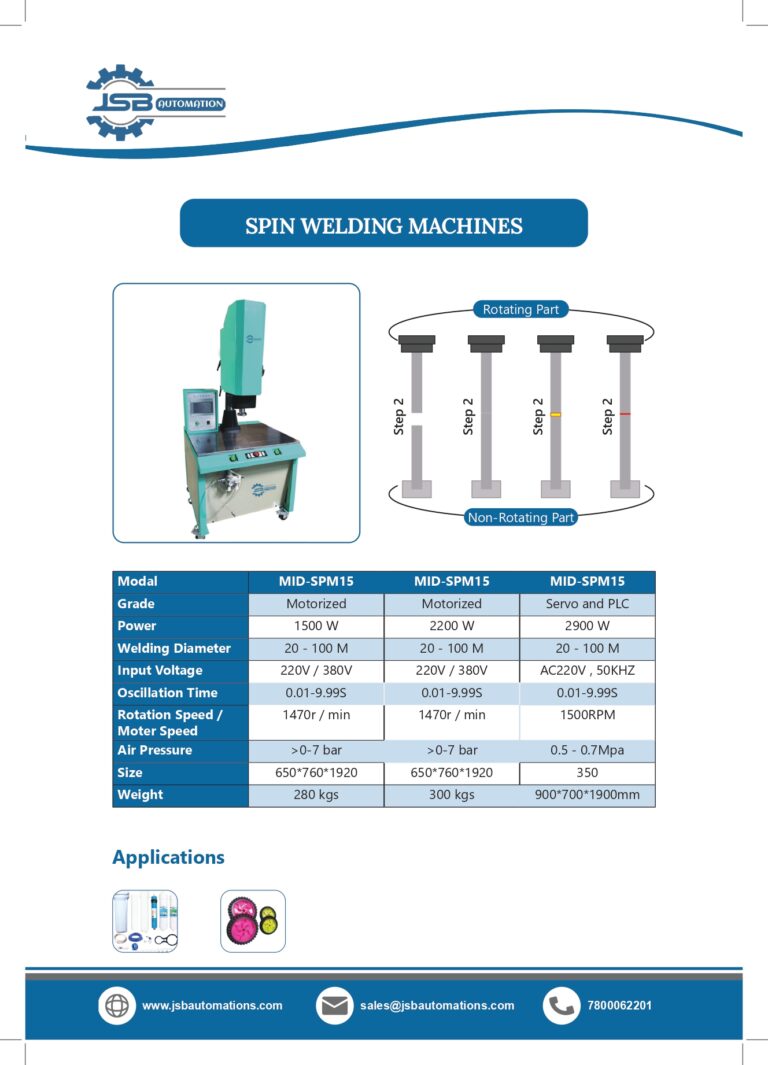
An ultrasonic plastic welding machine uses a generator, transducer, booster, horn and fixture to transfer controlled mechanical vibrations to thermoplastic components. At a properly designed joint, the vibration generates localized heat that softens the plastic. Pressure is maintained as the material cools and forms a joint.
In LED manufacturing, the process may be considered for compatible plastic housings, light covers, lens assemblies and lighting enclosures. The final suitability depends on the material grade, joint design, dimensions, sealing requirements and position of the electronic components.
For a relevant industrial example, ultrasonic welding systems are used in some LED backlight assemblies to join a transparent panel to a plastic housing while controlling the energy delivered to protect the integrated LEDs. Read an LED backlight welding application example.
LED Components That May Be Suitable for Ultrasonic Welding
Ultrasonic welding may be suitable for selected plastic-to-plastic joints used in lighting products.
| LED component | Potential application |
|---|---|
| LED bulb housing | Joining compatible plastic housing sections or covers. |
| LED wall light | Joining selected plastic body sections and diffuser assemblies. |
| LED panel light | Welding compatible plastic covers or enclosure components where the joint design permits. |
| LED street light | Joining selected plastic lens or housing components, subject to the product’s material and sealing requirements. |
| LED backlight module | Joining a suitable transparent plastic panel to a compatible housing. |
| LED driver enclosure | Joining compatible plastic enclosure halves or protective covers. |
These are potential applications, not a guarantee that every LED product can be welded ultrasonically. Glass lenses, metal housings and incompatible material combinations require other joining methods or a separately validated process.
How Ultrasonic Welding Helps LED Light Manufacturers
1. Fast joining cycles
Ultrasonic welding can provide short joining cycles for suitable plastic parts. Actual cycle time depends on the component, joint design, machine settings, handling and quality checks.
2. Reduced adhesive use
Where the joint design and materials are suitable, ultrasonic welding can eliminate the need for adhesive at the welded interface. This may simplify some assembly operations and avoid adhesive curing time.
3. Repeatable production
Appropriate fixtures and controlled welding parameters help maintain consistent component positioning and process conditions across production batches.
4. Clean assembly
The process can create a neat joint without screws or clips at the weld location. Horn design and process settings must be validated to prevent visible marks, flash or deformation on cosmetic surfaces.
5. Potential for sealed joints
A properly designed and validated ultrasonic weld may support a sealing requirement. However, water resistance or a specified IP rating cannot be assumed from the welding method alone. The finished lighting product must pass the required leak, ingress-protection and durability tests.
Which Plastic Materials Can Be Used?
Material compatibility is one of the first checks when choosing an ultrasonic welding machine for LED lights.
| Material | Selection considerations |
|---|---|
| ABS | May be suitable for selected housings and covers with an appropriate joint design. |
| Polycarbonate (PC) | Often evaluated for durable housings and transparent components; the grade and joint geometry must be checked. |
| Polypropylene (PP) | Requires suitable joint design and process development for reliable results. |
| PC-ABS blends | Suitability depends on the specific blend, grade and component design. |
| Acrylic (PMMA) | Requires particular attention to joint design, cosmetic quality and the risk of cracking or surface damage. |
Always verify the resin grade and test the actual components. Transparent parts and optical surfaces may require specialized tooling and process development to maintain appearance and performance.
How to Select the Right Ultrasonic Welding Machine for LED Lights
1. Check the size and shape of the LED component
Record the component’s length, width, height, wall thickness and weld-path geometry. A large rectangular lighting enclosure may need a different horn and fixture from a small round LED bulb housing.
2. Choose the appropriate frequency
Frequencies such as 15 kHz and 20 kHz are common options to evaluate for industrial plastic welding. Smaller or more detailed components may call for other frequencies, depending on tooling and application requirements. No single frequency is best for every LED component.
3. Estimate the required power
Generator power should be selected based on the material, joint geometry, weld area, tooling, cycle-time target and required process capability. Component size alone does not provide a reliable wattage calculation.
For example, a 15 kHz, 2600 W machine configuration is listed on JSB Automation’s product pages for certain LED wall-light and lighting-fixture applications. This is a reference configuration, not a universal recommendation for all LED products. The final machine must be confirmed against the actual part and welding trial.
4. Evaluate the horn and fixture
The horn must transfer vibration to the intended weld region, while the fixture supports the part without damaging its surface. Curved lenses, long perimeter joints and cosmetic surfaces may require application-specific tooling.
5. Protect the LED assembly
If LEDs, driver electronics, solder joints or other sensitive components are already installed, the process must be designed to prevent damaging vibration, excessive energy input or deformation. Depending on the product, welding the housing before installing sensitive electronics may be preferable.
6. Confirm the quality requirements
Define the required weld strength, appearance, dimensional accuracy and sealing performance. Conduct representative-part trials and validate the finished product against its acceptance criteria before moving to mass production.
Common LED Welding Problems and How to Reduce Them
| Problem | Possible cause | What to investigate |
|---|---|---|
| Weak joint | Unsuitable joint geometry, material mismatch or insufficient energy transfer. | Check resin compatibility, joint design, amplitude, pressure and weld settings. |
| Visible flash | Excessive material flow, pressure or energy. | Review the joint, fixture support and process parameters. |
| Marks on the lens | Unsuitable horn contact or excessive local loading. | Review horn geometry, contact surface and energy delivery. |
| Deformed housing | Excessive heat input or insufficient part support. | Review energy, pressure, hold time and fixture design. |
| Leakage after welding | Interrupted weld path, uneven contact or unsuitable joint design. | Inspect the joint and validate the product using the required leak or ingress-protection test. |
Change one process variable at a time during troubleshooting and record the results. This helps identify the cause instead of relying on trial and error without documentation.
What Information Should You Share Before Requesting a Quotation?
To help evaluate an ultrasonic welding machine for LED light manufacturing, prepare:
- Photographs and drawings of the LED component.
- Plastic material and grade for each part.
- Component dimensions and weld-path details.
- Required joint strength and sealing requirements.
- Whether electronic components are installed before welding.
- Daily production quantity and target cycle time.
- Surface-finish requirements, especially for transparent lenses.
- Any automation, inspection or traceability requirements.
Sample parts are especially useful when the component has a curved shape, a long weld path, transparent surfaces or a demanding sealing requirement.
Explore JSB Ultrasonic Plastic Welding Machines
JSB Ultrasonic supplies ultrasonic plastic welding equipment for industrial applications. If you manufacture LED bulbs, wall lights, panel lights, street lights or other lighting products, discuss your component material, joint design and production target before selecting a machine.
Explore the ultrasonic plastic welding machine category and read more about ultrasonic plastic welding for the electronics industry.
For application enquiries, contact JSB Ultrasonic directly. The company’s listed address is in Bawana, New Delhi; confirm delivery, installation and service arrangements for your location.
- Company: JSB Ultrasonic
- Address: N-76, DSIIDC Industrial Area, Sector 1, Bawana, New Delhi – 110039, India
- Phone: +91 7800062201 / +91 9958118545
- Email: sales@jsbautomation.com
Frequently Asked Questions
1. What is an ultrasonic welding machine for LED lights used for?
It can be used to join compatible thermoplastic components in LED lighting products, including selected housings, covers, diffusers and enclosures. Suitability depends on material compatibility and joint design.
2. Can ultrasonic welding be used for LED bulb housings?
It may be suitable when the housing parts are made from compatible thermoplastics and have an appropriate weld joint. Representative-part testing is recommended before finalizing the equipment.
3. Can an ultrasonic welding machine make LED lights waterproof?
A properly designed and validated weld can support a sealing requirement, but waterproof performance is not guaranteed by the welding process alone. The complete product must pass the specified leak or ingress-protection tests.
4. Which frequency is suitable for LED light welding?
15 kHz and 20 kHz are options to evaluate for many industrial plastic-welding applications. The correct frequency depends on component geometry, material, weld path, horn design and required output.
5. Can ultrasonic welding damage LED electronics?
It can if the process is poorly matched to the assembly. Welding parameters, tooling and assembly sequence should be selected to limit harmful vibration and energy transfer to sensitive components.
6. Does ultrasonic welding eliminate adhesive in LED manufacturing?
It can eliminate adhesive at suitable welded joints. Other parts of the lighting product may still require adhesives, gaskets or separate sealing methods to meet electrical, environmental or mechanical requirements.
7. What details are required to select an LED welding machine?
Provide material grades, component drawings or samples, dimensions, weld-path details, quality requirements, daily production volume and expected cycle time. These details help determine the machine, horn and fixture requirements.
Related Articles